

All information is based on current medical research (2018–2026). Written specifically for patient education by Dr. Antonio Gargiulo. This article does not replace a consultation with your gynecologist or healthcare provider.
The Hottest Question in My Office Right Now
Almost every week now, a patient asks me some version of the same question: “Doctor, could Ozempic help my endometriosis?” They have seen the headlines. They have read a story about a woman whose endometriosis pain melted away on Wegovy. They have friends in online groups swapping stories about semaglutide and “endo belly.” And the idea is genuinely exciting: what if one of these blockbuster weight-loss and diabetes drugs — the ones everyone is talking about — could also quiet a disease that has been treated the same two ways (hormones and surgery) for decades?
It is a fair and smart question, and I want to answer it honestly. So let me tell you where I land before I explain why, because I would rather be clear than coy: the idea is biologically reasonable and worth studying, but right now there is essentially no real proof that these drugs treat endometriosis. Not a single completed clinical trial. What we have instead is a handful of patient surveys, one case report, one hypothesis paper, and a lot of laboratory reasoning. That is a very thin foundation to build a treatment decision on — and, as you will see, there is even a reason for reproductive-age women to be a little cautious.
This is one of those topics where the science is moving faster than the evidence. My job is to keep those two things separate for you.
What Are GLP-1 and GIP Drugs, and What Are They Actually For?
Let me start with plain definitions, because the names get thrown around loosely.
Your gut naturally makes hormones after you eat. Two of them are called GLP-1 (glucagon-like peptide-1) and GIP (glucose-dependent insulinotropic polypeptide). They tell your body to release insulin, they slow down how fast your stomach empties, and they signal your brain that you are full. The new drugs are lab-made copies that turn those same signals way up. That is why they lower blood sugar and cause weight loss.
Here is the family, by their brand names:
- Semaglutide — sold as Ozempic (for diabetes) and Wegovy (for weight loss). It copies GLP-1.
- Liraglutide — an older GLP-1 drug (Victoza, Saxenda).
- Tirzepatide — sold as Mounjaro (diabetes) and Zepbound (weight loss). This one is a dual drug: it copies both GIP and GLP-1 at once[1].
The single most important thing to understand: these drugs are approved for type 2 diabetes and for obesity — and only for those[2]. They are not approved, anywhere, to treat endometriosis. Any use of them for endometriosis today would be “off-label,” meaning a doctor is using an approved drug for an unapproved purpose, without the evidence that normally backs that up.
Why the Idea Makes Biological Sense
Here is the part that makes this more than internet hype: there is a real, sensible scientific story behind why these drugs might help. Endometriosis is not just misplaced tissue — it is a condition driven by chronic inflammation (your body’s overreactive “fire alarm” response) and by pain nerves that become over sensitized over time[3]. GLP-1 drugs happen to act on both of those systems.
They calm inflammation. GLP-1 drugs do a lot more than lower blood sugar. They reduce inflammation throughout the body by quieting a master inflammation switch (called NF-κB), lowering inflammatory chemicals, and calming down the immune cells — macrophages — that drive a lot of the damage[2]. Those very same macrophages are central players in endometriosis lesions.
They may quiet pain. Beyond diabetes, researchers have found that GLP-1 drugs can reduce nerve inflammation and dial down pain signaling, including the kind of deep “visceral” pain that comes from internal organs — exactly the flavor of pain endometriosis causes[4].
There is an obesity-inflammation connection. Endometriosis and obesity share a surprising amount of biology: the same inflammatory signals (with names like leptin, TNF-α, and interleukin-6) show up in both[3]. In the laboratory, GLP-1 has been shown to reduce pro-inflammatory secretions and calm the immune cells that infiltrate tissue[3]. So the reasoning goes: a drug that cools inflammation and trims fat tissue might, in theory, make the environment less friendly to endometriosis.
The boldest version of the idea. In 2026, a team proposed a detailed hypothesis that tirzepatide (the dual GIP/GLP-1 drug) could hit four different problem pathways in stubborn endometriosis at once — abnormal cell metabolism, immune dysfunction, scarring, and pain sensitization[1]. It is a genuinely interesting framework. But the authors were refreshingly honest about what it is: they wrote that the idea rests on a single, non-replicated study and on evidence borrowed from other diseases, that direct proof in endometriosis is “currently absent,” and that their paper is a “hypothesis-generating framework rather than evidence of established efficacy”[1].
So the mechanism is plausible. Plausible is a good reason to study something. It is not the same as proof that it works.
What the Evidence Actually Is Right Now
This is the heart of the article, so let me be very direct. When you ask “does it work?”, the honest answer depends entirely on what kind of evidence you are willing to count. The figure below shows the “evidence ladder” — the different grades of proof, from the strongest at the top to the weakest at the bottom.
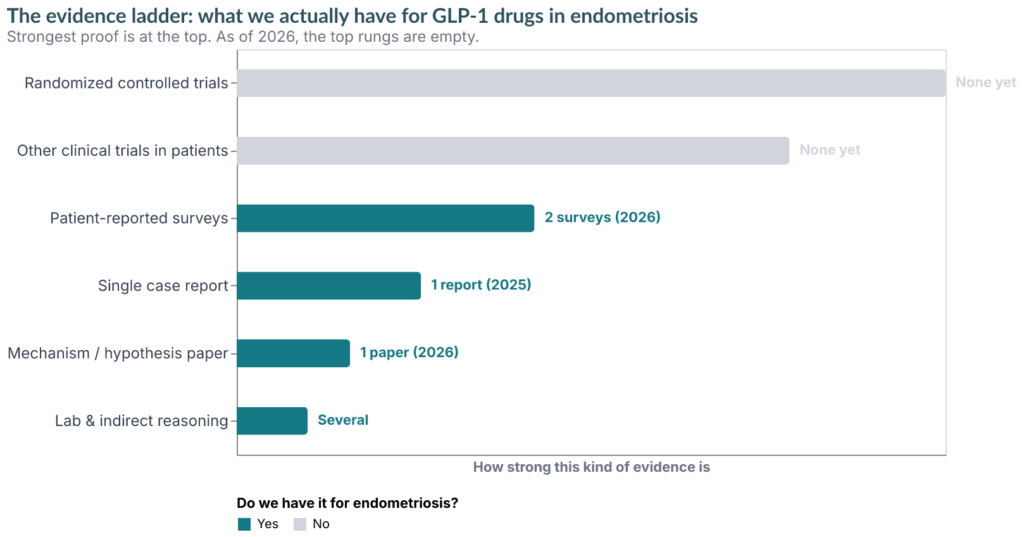
Figure 1. The evidence for GLP-1 receptor agonists in endometriosis sits near the bottom of the evidence ladder. As of 2026 there are no randomized controlled trials and no non-randomized clinical trials in endometriosis patients; the human evidence is limited to two patient-reported surveys and a single case report, plus a mechanistic hypothesis paper and indirect laboratory reasoning. The registered clinical-trial search returned nothing for endometriosis.
Here is what sits on each rung for endometriosis:
The top rungs are empty. There are no randomized controlled trials — the gold-standard studies that compare the drug against a placebo — testing GLP-1 or GIP drugs for endometriosis. In fact, a search of the clinical-trials registry turns up no completed trials of these drugs in endometriosis patients at all. This is the single most important fact in the whole article.
What we do have is near the bottom:
- Two patient surveys (2026). The larger one asked 161 women with endometriosis who had used a GLP-1 drug (mostly semaglutide) how they felt[5]. The results sound encouraging: about 65% reported improvement in at least one endometriosis symptom, a third reported that at least one symptom fully resolved, and there were reported improvements in pelvic pain, bloating, and quality of life[5]. The authors’ own conclusion was appropriately careful — this shows an association with self-reported improvement, and “prospective studies are warranted”[5]. The second, a patient-led study called GLEAM, is specifically trying to answer the crucial question surveys like this cannot: is any improvement actually from the drug, or just from losing weight? It makes “no causal claims” and calls its own findings “patient-reported signals intended to motivate controlled research”[6].
- One case report (2025). A single patient with severe period pain that had resisted standard treatment improved on semaglutide — notably, with no change in her weight — leading the authors to guess at anti-inflammatory and anti-estrogen effects and to conclude that “a controlled trial is warranted”[7]. A case report is a story about one person. It generates ideas; it does not prove them.
- A hypothesis paper and lab reasoning — the tirzepatide framework and the inflammation/pain science from Section 2.
Why does the rung matter so much? Because surveys and case reports are the levels of evidence most easily fooled. Women who feel better are more likely to answer a survey and report it. People who expect a drug to help often do feel better — the placebo effect is powerful, especially for pain. And none of these studies had a comparison group taking a dummy treatment. That is not a knock on the researchers; it is simply what this early evidence can and cannot tell us. It can tell us the question is worth a real trial. It cannot tell you the drug will help you.
What this means for you: Right now, “GLP-1 drugs treat endometriosis” is a promising hypothesis, not a proven fact. The excitement is real, but it is running about a decade ahead of the proof.
The Weight-Loss Trap — Is It the Drug, or Is It the Pounds?
This is the question that keeps honest researchers up at night, and it is worth understanding because it is genuinely tricky.
When a woman loses a large amount of weight on one of these drugs — in the larger survey, an average of about 12 kilograms (roughly 26 pounds)[5] — a lot of good things happen to her body at once. Less weight can mean less mechanical strain, better mood, better sleep, less body-wide inflammation, and often less pain of many kinds. So if her endometriosis symptoms improve, was it the drug acting on the disease, or was it simply the weight loss? In that same survey, greater weight loss lined up with greater improvement in quality of life[5] — which is exactly the pattern you would expect if weight loss, not a direct anti-endometriosis effect, were doing the work.
There is an even stranger wrinkle here that most articles miss. The relationship between body weight and endometriosis is not what you would assume: studies have repeatedly found that endometriosis is, if anything, more common in leaner women, not heavier ones — an inverse relationship that researchers still do not fully understand and that may be a coincidence of how the disease is found and diagnosed rather than a true protective effect of higher weight[3]. That single fact should make anyone cautious about assuming “lose weight, cure endo.”
The one intriguing counterpoint is that case report, where the patient improved without losing weight[7] — and the entire purpose of the GLEAM survey is to look specifically for improvement in women who did not lose much weight[6]. If that signal holds up in a real trial, it would suggest a direct effect. But “if it holds up in a real trial” is doing enormous work in that sentence. As of today, we cannot separate the drug from the weight loss, and that alone means we cannot claim the drug treats the disease.
A Real Caution — These Drugs and Your Fertility
This is the part I most want my reproductive-age patients to hear, because it flips the usual “miracle drug” framing on its head. For a woman who has endometriosis and wants to get pregnant — which describes a great many of my patients — GLP-1 drugs come with genuine reproductive cautions, not just an unproven benefit.
First, the straightforward part: these drugs are not considered safe in pregnancy, and the guidance is to stop them well before trying to conceive. Researchers reviewing their reproductive effects have explicitly flagged safety concerns about birth defects and effects on a developing baby for women who conceive during or soon after treatment[8].
Second, the subtler and more surprising part. It turns out the lining of the uterus — the endometrium — carries GLP-1 receptors, and they switch on most strongly right during the window when an embryo would implant[9]. When researchers studied semaglutide in laboratory models of human endometrium and embryos in 2026, they found a mixed and slightly worrying picture: at normal doses the drug nudged some receptivity markers in a helpful direction, but it also disrupted the supportive “nest-building” behavior of the uterine lining’s deeper cells and stressed them, creating what the authors called a “compartment-specific mismatch” that could interfere with implantation[9]. And the honest summary from the broader review of this question is simply that the effects of these drugs on the endometrium and on implantation “remain unclear,” and that more study is needed before we can call them safe for the uterus[8].
What this means for you: If you are trying to conceive or planning to soon, this is not a drug to reach for in the hope of calming your endometriosis. At best its effect on your disease is unproven; at worst it may complicate the very implantation you are trying to achieve, and it needs to be stopped before pregnancy regardless.
My Take
Here is how I counsel patients who bring me this question.
If you do not have diabetes or obesity, I would not start a GLP-1 drug to treat your endometriosis. There is no trial evidence that it works, there is a real fertility caution if you want to conceive, and reaching for an unproven off-label drug means potentially delaying the treatments that we know help — good hormonal management and, when appropriate, skilled excision surgery. I have spent a career on those tools precisely because they have earned their place.
If you are already taking one of these drugs for diabetes or obesity, and your endometriosis symptoms feel better — that is wonderful, and there is no reason to stop it for endometriosis’s sake. Enjoy the benefit. Just understand what it is: a welcome bonus from a drug you are taking for another good reason, not a targeted endometriosis therapy, and not a substitute for your endometriosis care. And if pregnancy is on your horizon, plan the timing of stopping it with your doctor.
And if you are excited about the science — good. So am I. The mechanism is plausible, the early patient reports are intriguing, and I genuinely hope a proper randomized trial gets funded and run, because these women deserve more options. But hope for a future trial is not a reason to make a decision today on evidence this thin. When the real trials read out, I will tell you what they found — good or bad.
A Note on Hope, Hype, and the Speed of Science
Every few years a drug that was designed for one thing turns out to help with something else entirely, and medicine is better for it. GLP-1 drugs may yet earn a place in how we think about the inflammation of endometriosis. But there is a predictable pattern to how these stories unfold in the press: a plausible mechanism and a few dramatic anecdotes get written up as “the new cure,” years before anyone has actually tested it in a controlled way. Endometriosis, a disease that has been dismissed and under-researched for generations, is especially vulnerable to that kind of premature excitement — because these women are, understandably, desperate for something new.
So hold both things at once. It is reasonable to be hopeful about this class of drugs and to want the research done. It is also reasonable — necessary, really — to keep treating your disease today with what actually works, and not to gamble your fertility or your pain control on a headline. Hope for the future. Care for today.
Continue reading: “Endometriosis and Adenomyosis: Two Diseases, One Patient” — how these two conditions overlap, why they are so often missed together, and what that means for your care.
Sources We Used
So You Can Read Them, Question Them, and Decide for Yourself
We believe that informed patients are empowered patients. In an age where artificial intelligence and open-access science place original research within reach of anyone, you have every right to go to the source, read it yourself, and form your own conclusions. Patient education on this website is taken seriously: we do not simplify at the cost of truth, and we do not ask you to take our word for it.
Every statement in this article carries two layers of accountability. It has been filtered through the critical eye of Dr. Antonio Gargiulo, drawing on four decades of clinical and surgical experience in reproductive medicine and advanced gynecologic surgery. And it is independently traceable to a peer-reviewed publication or primary source, listed below, so you can retrieve and read the original at any time.
We see healthcare as a shared responsibility between doctors and patients. Shared responsibility requires shared access to information. These references are not a formality. They are here for you.
- Gholiof M, Kalani N, Leonardi M. Effects of Glucagon-Like Peptide-1 Receptor Agonists (GLP-1RAs) on Endometriosis Symptoms Management and Quality of Life: An International Survey Study. Preprint (Authorea). 2026. DOI: 10.22541/au.177194722.27223197/v1
- Baudoin B, van Bakel L. GLEAM: GLP-1 receptor agonists and endometriosis symptoms — an international cross-sectional survey. OSF Preprints. 2026. DOI: 10.17605/osf.io/6qjke
- Tran M, Swartz N, Elisèe SD. Refractory Dysmenorrhea Managed With a Glucagon-Like Peptide-1 Agonist: A Case Report. Cureus. 2025.
- Jacobsen L, Pinto da Costa Viana D, Folador GM, Schor E, Invitti AL. Peritoneal Incretin Deficiency and Tirzepatide as a Multi-Axis Adjuvant Hypothesis in Treatment-Refractory Endometriosis: A Mechanistic Framework Linking Metabolism, Immunity, Fibrosis, and Nociception. International Journal of Molecular Sciences. 2026. DOI: 10.3390/ijms27135678
- Ros-Madrid I, Cano-Mármol RP, Ferrer-Gómez M, Ramos-Molina B. Anti-inflammatory properties of GLP-1 receptor agonists and other ancillary benefits from a pharmacological perspective. 2025.
- Jing F, Zeng Y, Yu Q, Fu C. The role of GLP-1 receptor in pain disorders and its pharmacological properties. 2025.
- Desai S, Reed C, Mendez YH, Yang Q, Guan X. The Hidden Link Between Endometriosis and Obesity: A State-of-the-Art Review. Cureus. 2026.
- Sola-Leyva A, Pathare ADS, Apostolov A, et al. The hidden impact of GLP-1 receptor agonists on endometrial receptivity and implantation. Acta Obstetricia et Gynecologica Scandinavica. 2024. DOI: 10.1111/aogs.15010
- Apostolov A, Pathare ADS, Lavõgina D, et al. Semaglutide alters the human embryo-endometrium interface. Preprint (medRxiv). 2026. DOI: 10.1101/2026.03.03.26347354
References
1. Jacobsen L, Viana DP da C, Folador GM, et al (2026) Peritoneal Incretin Deficiency and Tirzepatide as a Multi-Axis Adjuvant Hypothesis in Treatment-Refractory Endometriosis: A Mechanistic Framework Linking Metabolism, Immunity, Fibrosis, and Nociception. International Journal of Molecular Sciences. https://doi.org/10.3390/ijms27135678
2. Ros-Madrid I, Cano-Mármol RP, Ferrer-Gómez M, Ramos-Molina B (2025) ANTI-INFLAMMATORY PROPERTIES OF GLP-1 RECEPTOR AGONISTS AND OTHER ANCILLARY BENEFITS FROM A PHARMACOLOGICAL PERSPECTIVE. Canadian Journal of Physiology and Pharmacology. https://doi.org/10.1139/cjpp-2025-0148
3. Desai S, Reed C, Mendez YH, et al (2026) The Hidden Link Between Endometriosis and Obesity: A State-of-the-Art Review. Cureus. https://doi.org/10.7759/cureus.102896
4. Jing F, Zeng Y, Yu Q, Fu C (2025) The role of GLP-1 receptor in pain disorders and its pharmacological properties. European Journal of Pharmacology. https://doi.org/10.1016/j.ejphar.2025.178345
5. Mahsa Gholiof NK Mathew Leonardi Effects of Glucagon-Like Peptide-1 Receptor Agonists (GLP-1RAs) on Endometriosis Symptoms Management and Quality of Life: An International Survey Study. https://doi.org/10.22541/au.177194722.27223197/v1
6. Bas Baudoin L van B GLEAM: GLP-1 receptor agonists and endometriosis symptoms — an international cross-sectional survey. https://doi.org/10.17605/osf.io/6qjke
7. Tran M, Swartz N, Elisèe SD (2025) Refractory Dysmenorrhea Managed With a Glucagon-Like Peptide-1 Agonist: A Case Report. Cureus. https://doi.org/10.7759/cureus.77387
8. Sola-Leyva A, Pathare A, Apostolov A, et al (2024) The hidden impact of GLP‐1 receptor agonists on endometrial receptivity and implantation. Acta Obstetricia et Gynecologica Scandinavica. https://doi.org/10.1111/aogs.15010
9. Apostolov A, Pathare A, Lavõgina D, et al (2026) Semaglutide alters the human embryo-endometrium interface. medRxiv. https://doi.org/10.64898/2026.03.03.26347354