
All information is based on current medical research (2018–2026). Written specifically for patient education by Dr. Antonio Gargiulo. This article does not replace a consultation with your gynecologist or healthcare provider.
What Does “Autoimmune” Even Mean?
Your immune system is your body’s security team. Its job is to recognize your own cells as “you,” and to attack anything that is not — germs, viruses, infected cells. In an autoimmune disease, the security team makes a serious mistake: it starts attacking your own healthy tissue as if it were an invader. Type 1 diabetes, lupus, and rheumatoid arthritis all work this way — the immune system turns on the body and causes damage.
So it is a fair question to ask: is endometriosis one of these diseases? You may have read online that it is, or that it is closely tied to autoimmunity. Many of my patients come in having read exactly that, and they ask me to order a full set of rheumatology blood tests — the whole panel that checks for lupus, arthritis, thyroid disease, and more. The instinct makes sense, and it is built on a real signal in the research[1, 2]. If you have spent years in pain that no one took seriously, and you finally read that your disease might be connected to a whole family of other misunderstood conditions, of course you want the tests.
The honest answer sits between “yes, test everything” and “no, ignore it.” There is a real, population-wide link between endometriosis and several autoimmune conditions. But there is a big gap between “women with endometriosis are somewhat more likely to have these conditions” and “you personally need a full autoimmune workup.” The scientists who ran the largest and most careful genetic study on this said so themselves: the takeaway, in their words, is awareness and vigilance — not routine screening[3]. This article explains that gap in plain language.
Is Endometriosis an Autoimmune Disease?
No — at least not in the classic sense. To be called a true autoimmune disease, a condition usually has to meet certain marks: there is a clear target the immune system attacks, the disease gets better when you calm the immune system down with medicines called immunosuppressants, and it behaves like the known autoimmune diseases such as lupus. Endometriosis does not tick those boxes. The most detailed recent reviews describe it as immune-mediated, not classically autoimmune[4].
What is the difference? Think of it this way. In a true autoimmune disease, the security team is attacking the building it is supposed to protect. In endometriosis, the security team is not so much attacking the body as failing to do its job — it does not clean up the stray endometrial cells that end up in the wrong place, and it behaves in a confused, over-inflamed way while it fails. A large 2025 review that pulled together 198 high-quality studies described exactly this kind of immune malfunction: cleanup cells (macrophages) that switch to the wrong mode, natural killer cells that lose their punch, and an inflammatory environment that lets misplaced tissue survive and grow[4]. That is a lot of immune trouble — but it is a different kind of trouble than an autoimmune attack.
Why does this matter to you? Because it changes how the disease is treated. If endometriosis were truly autoimmune, we would treat it with immune-suppressing drugs, the way we treat lupus or rheumatoid arthritis. We do not, because those drugs do not work well for it. Immune-targeting treatments for endometriosis are still experimental — promising ideas being studied, not standard care[4]. What actually works is treatment aimed at estrogen (the hormone that feeds the disease) and well-done surgery to remove the tissue. That is simply not how autoimmune diseases are managed.
The Link is Real — but Smaller Than the Internet Suggests
Researchers have now studied this question in big ways: large reviews that combine dozens of studies, nationwide health records covering hundreds of thousands of women, and — most recently — genetic studies that can hint at cause and effect. They all point to the same picture. Yes, there is a link. But for most conditions the extra risk is modest, and the older studies were not always high quality[1, 5].
The most-cited review (Shigesi and colleagues, 2019) combined 26 population studies and found that endometriosis was linked to lupus, Sjögren’s syndrome, rheumatoid arthritis, autoimmune thyroid disease, celiac disease, multiple sclerosis, inflammatory bowel disease, and Addison’s disease[1]. The important catch, in the authors’ own words: the evidence was generally weak, and only 5 of the 26 studies were high quality[1]. The link is real; how big it is, we are less sure.
The largest recent records study (Aziz and colleagues, 2025) looked at 332,409 women with endometriosis and more than 1.2 million similar women without it. Women with endometriosis were about twice as likely to be diagnosed with at least one autoimmune condition within two years — including rheumatoid arthritis, Hashimoto’s thyroid disease, lupus, multiple sclerosis, pernicious anemia, Sjögren’s, and myositis[2]. “Twice as likely” sounds dramatic, but remember these are still uncommon diagnoses, so twice a small number is still a small number.
The most careful genetic study (Shigesi and colleagues, 2025, using the UK Biobank with 8,223 women with endometriosis) found a 30–80% higher risk of rheumatoid arthritis, multiple sclerosis, celiac disease, osteoarthritis, and psoriasis[3]. Using a genetic method that can suggest cause rather than coincidence, the study found a likely causal link for only one disease — rheumatoid arthritis — and even that effect was small[3]. The authors’ own bottom line is worth repeating: the clinical takeaway is “increased awareness and vigilance”[3]. Not a full-panel test for everyone.
One study that pumps the brakes. The Nurses’ Health Study II — one of the best-run long-term studies we have — found that surgically confirmed endometriosis was linked to later lupus and rheumatoid arthritis, but the link faded and became statistically meaningless once the researchers accounted for hysterectomy and ovary removal[6]. In plain terms: some of the “endometriosis raises autoimmune risk” signal may actually come from the surgeries these women have, not from endometriosis itself. That is not a reason to dismiss the link — it is a reason to stay humble about its size.
So, the takeaway on the numbers. Endometriosis is tied to a modestly higher chance of a few immune conditions — most solidly rheumatoid arthritis, the one with a real cause-and-effect signal[3], and probably also multiple sclerosis, celiac disease, and autoimmune thyroid disease[3]. In most cases the actual jump in risk is real but small. The figure below sorts the conditions by how well-established the link actually is — a useful way to see that not every connection you read about online is equally proven.
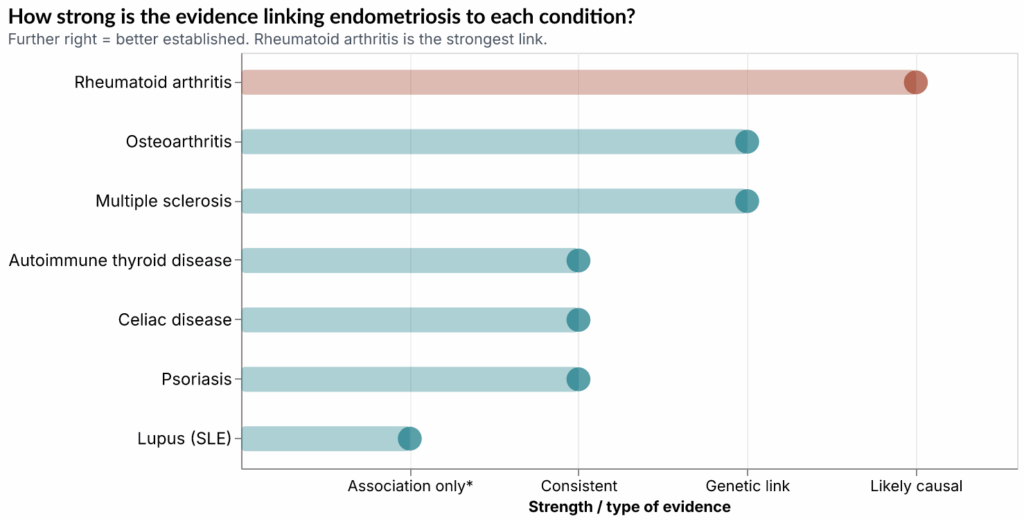
Figure 1. Endometriosis has been tied to several immune conditions, but the strength and type of evidence differs a lot. Rheumatoid arthritis is the standout: it shows a population association, a shared genetic signal, and the only likely cause-and-effect link (a small one, with about 16% higher odds). Osteoarthritis and multiple sclerosis show a genetic correlation as well. Celiac disease and psoriasis show a population association, autoimmune thyroid disease is consistently reported across cohorts, and the lupus signal weakened to non-significant once surgery was accounted for. Higher on the ladder means the connection is better established – not that your personal risk is high. (*Association only: the lupus signal weakened once factors such as surgery were accounted for.)
Why a Positive Antibody Does Not Mean You Have a Disease
This is where bad internet articles, marketing labs, and even some well-meaning practitioners do real harm. Women with endometriosis are more likely than other women to have autoantibodies in their blood — proteins the immune system makes that can point toward autoimmunity. A 2024 review of 41 studies (2,825 women with endometriosis versus 4,158 without) found that women with endometriosis were about four times as likely to test positive for one of these antibodies, including the common one called ANA[7].
That sounds scary — until you understand what a positive antibody test really means.
Here is the key fact: autoantibodies are common in perfectly healthy people. In a large general-population study, about 13 of every 100 healthy women with no autoimmune disease at all tested positive for ANA at some level, and about 6 at a higher level — and being positive was not linked to any higher risk of cancer or death[8]. The figure below shows what that looks like.
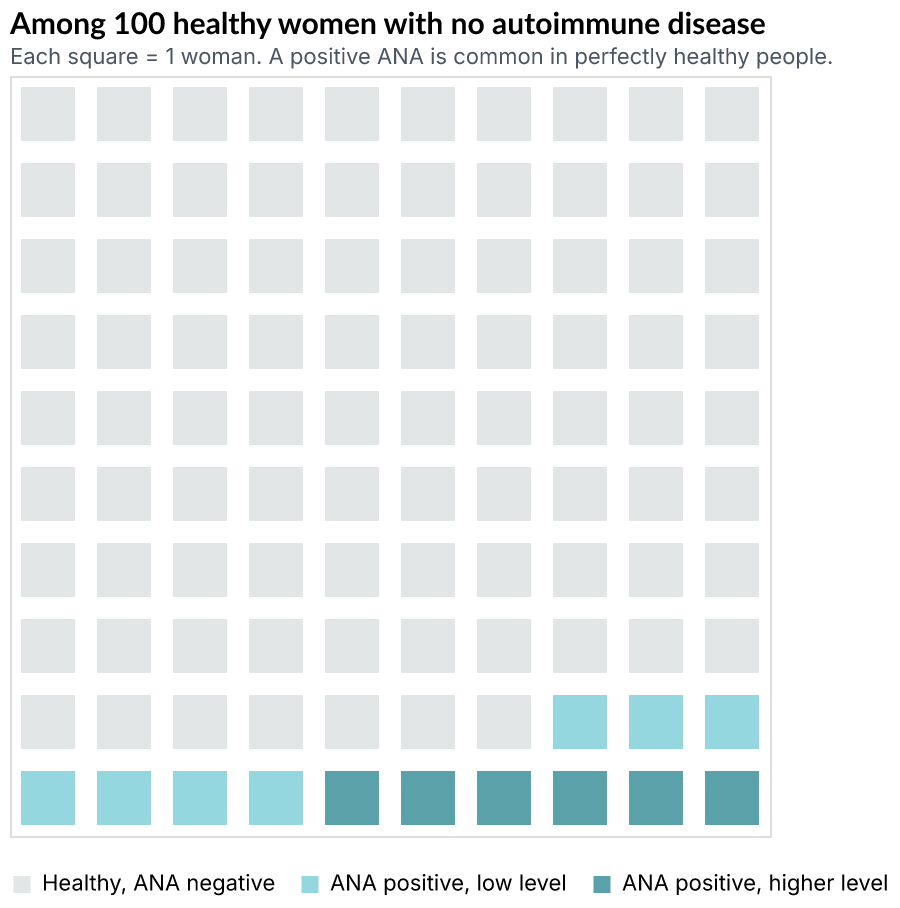
Figure 2. In a large general-population study, about 13 of every 100 healthy women (with no autoimmune disease) tested positive for antinuclear antibodies (ANA) at some level, and about 6 at a higher level. Critically, ANA positivity in this population was not linked to higher cancer or death risk. This is why a single positive ANA does not, by itself, diagnose a disease — its meaning depends on the titer, the pattern, the specific antibody, and above all your actual symptoms.
A positive ANA, by itself, is not proof of anything — which is exactly why the recent review literature calls the endometriosis–autoimmunity link “inconclusive” for any individual patient, even though the population link is real[5]. A positive antibody is a clue, not a verdict. What actually matters is:
- How high the level is. A positive at a low level is often meaningless. A high level is a different conversation.
- The pattern. These tests come back in different patterns, and some patterns point to real disease while others point to nothing.
- Which specific antibody. ANA is just a wide net. More specific antibodies (with names like anti-dsDNA, anti-CCP, anti-Ro) are the ones that actually help make or refine a diagnosis.
- Your actual symptoms. No antibody, on its own, makes a diagnosis. Swollen painful joints, a facial rash, mouth ulcers, kidney findings — the real symptoms are what turn a lab number into a disease. The fact that these antibodies are so common in endometriosis is exactly why finding one does not, by itself, mean anything[7].
A woman with endometriosis who is told her ANA is “positive” at a low level and is then labeled “autoimmune” has, in most cases, been misled — the research specifically warns that a positive antibody in this situation should be read carefully, not treated as a diagnosis[5]. Now she carries a scary label in her chart for the rest of her life, may get treatments she does not need, and lives with real anxiety — all over a finding that often means nothing at all.
What Should Actually Be Tested — and When
Here is the practical part. The answer is not “test nothing,” and it is not “test everything.” It is: test what your symptoms point to, and test it the right way.
Reasonable for most women with endometriosis (thyroid problems show the most consistent link across studies[1, 2]):
- A thyroid test (TSH), with thyroid antibodies added only if the TSH comes back abnormal. A normal TSH is a cheap, useful check. Full thyroid-antibody panels in a woman with a normal TSH and no symptoms are usually not helpful.
- A basic blood count and metabolic panel. These are standard for anyone with a long-term inflammatory condition and are often already done.
- Vitamin D and iron studies, especially if your periods are heavy. Iron-deficiency anemia is common with endometriosis and worth catching.
Reasonable when you have specific symptoms (rheumatoid arthritis, multiple sclerosis, celiac disease, and Sjögren’s have the strongest links, so it makes sense to test for them when symptoms fit[2, 3]):
- Joint pain, swelling, or morning stiffness lasting more than an hour? Then tests for rheumatoid arthritis and a referral to a rheumatologist — but not before.
- Rash across the cheeks, hair loss, mouth sores, unexplained fevers, chest pain, or something odd on a urine test? Now an ANA makes sense, followed by more specific tests if it is positive, and a rheumatology referral.
- Ongoing diarrhea, weight loss, or iron deficiency that is worse than your period would explain? Then celiac tests are appropriate — but not before.
- Dry eyes and dry mouth? Then tests for Sjögren’s syndrome.
- Numbness, weakness, or vision changes? Then a neurology workup for multiple sclerosis.
Not helpful for a woman with no symptoms (the same research that documents the link specifically warns against testing everyone[3, 5]):
- Broad “autoimmune panels” that test for every antibody at once. These produce lots of meaningless low-level positives that cause anxiety and lead to more unnecessary testing.
- An ANA in a woman with no signs of connective-tissue disease. The false-alarm rate is so high that you are more likely to be misled than helped.
- Antibody testing to “confirm” endometriosis. Autoantibodies are not a test for endometriosis, no matter what some labs advertise.
If a real symptom points to an autoimmune disease, the right next step is the right specialist — a rheumatologist, endocrinologist, gastroenterologist, or neurologist — and I refer accordingly. But if nothing points that way, ordering the whole panel just to calm the worry an internet article created is not good care. The very same studies that prove the link also warn against reading too much into it for any one patient[1, 3].
A Note on Where This Fits in Your Care
There is one more conversation I want to head off, because it comes up often. Some patients read about the autoimmune link and conclude that endometriosis is “really” an immune disease, that hormones and surgery are treating the wrong problem, and that the right diet or supplement or immune treatment would make it disappear. There is no evidence for this. The current research treats immune-targeting therapy as a future possibility being studied — not something that works today[4]. What treats endometriosis is hormonal management and properly performed excision surgery.
So take the autoimmune signal for exactly what it is: a reason for what the largest recent study called increased awareness and vigilance[3] — to pay attention to specific symptoms, to test the right things at the right time, and to keep a good primary-care and specialist team around you. Do not let it become a reason to walk away from the treatments that actually work while you wait for a blood panel to explain everything.
Continue reading: “Endometriosis and Adenomyosis: Two Diseases, One Patient” — how these two conditions overlap, why they are so often missed together, and what that means for your care.
Sources We Used
So You Can Read Them, Question Them, and Decide for Yourself
We believe that informed patients are empowered patients. In an age where artificial intelligence and open-access science place original research within reach of anyone, you have every right to go to the source, read it yourself, and form your own conclusions. Patient education on this website is taken seriously: we do not simplify at the cost of truth, and we do not ask you to take our word for it.
Every statement in this article carries two layers of accountability. It has been filtered through the critical eye of Dr. Antonio Gargiulo, drawing on four decades of clinical and surgical experience in reproductive medicine and advanced gynecologic surgery. And it is independently traceable to a peer-reviewed scientific publication, listed below with its full reference and digital identifier (DOI), so you can retrieve and read the original source at any time.
We see healthcare as a shared responsibility between doctors and patients. Shared responsibility requires shared access to information. These references are not a formality. They are here for you.
- Shigesi N, Kvaskoff M, Kirtley S, et al. The association between endometriosis and autoimmune diseases: a systematic review and meta-analysis. Human Reproduction Update. 2019. DOI: 10.1093/humupd/dmz014
- Shigesi N, Harris HR, Fang H, et al. The phenotypic and genetic association between endometriosis and immunological diseases. Human Reproduction. 2025. DOI: 10.1093/humrep/deaf062
- Aziz M, Beaton M, Aziz M, Opoku-Anane J, Elhadad N. Endometriosis and autoimmunity: a large-scale case-control study of endometriosis and 10 distinct autoimmune diseases. npj Women’s Health. 2025. DOI: 10.1038/s44294-025-00086-8
- Shifon S, Tyrinova T, Veretelnikova T, Pasman N, Chernykh ER. Endometriosis as an immune-mediated disease: pathogenetic mechanisms and therapeutic strategies. Frontiers in Immunology. 2025. DOI: 10.3389/fimmu.2025.1727183
- Fekri S, Makoui RH, Ansari N, Makoui MH. Correlation between the existence of serum autoantibodies and the risk of endometriosis: a systematic review and meta-analysis. Turkish Journal of Obstetrics and Gynecology. 2024. DOI: 10.4274/tjod.galenos.2024.77489
- Harris HR, Costenbader KH, Mu F, et al. Endometriosis and the risks of systemic lupus erythematosus and rheumatoid arthritis in the Nurses’ Health Study II. Annals of the Rheumatic Diseases. 2016.
- Rus A, Căpîlna MG, Hălmaciu I. The link between endometriosis and autoimmune diseases: a myth or reality? Obstetrica şi Ginecologia. 2024.
References
1. Shigesi N, Kvaskoff M, Kirtley S, et al (2019) The association between endometriosis and autoimmune diseases: a systematic review and meta-analysis. Human Reproduction Update. https://doi.org/10.1093/humupd/dmz014
2. Aziz M, Beaton M, Aziz M, et al (2025) Endometriosis and autoimmunity: a large-scale case-control study of endometriosis and 10 distinct autoimmune diseases. npj Women’s Health. https://doi.org/10.1038/s44294-025-00086-8
3. Shigesi N, Harris H, Fang H, et al (2025) The phenotypic and genetic association between endometriosis and immunological diseases. Human Reproduction. https://doi.org/10.1093/humrep/deaf062
4. Shifon S, Tyrinova T, Veretelnikova T, et al (2025) Endometriosis as an immune-mediated disease: pathogenetic mechanisms and therapeutic strategies. Frontiers in Immunology. https://doi.org/10.3389/fimmu.2025.1727183
5. Rus A, Căpîlna M, Hălmaciu I (2024) The link between endometriosis and autoimmune diseases: a myth or reality? Obstetrica si ginecologia. https://doi.org/10.26416/obsgin.72.4.2024.10887
6. Harris H, Costenbader K, Mu F, et al (2015) Endometriosis and the risks of systemic lupus erythematosus and rheumatoid arthritis in the Nurses’ Health Study II. Annals of the Rheumatic Diseases. https://doi.org/10.1136/annrheumdis-2015-207704
7. Fekri S, Makoui RH, Ansari N, Makoui MH (2024) Correlation between the existence of serum autoantibodies and the risk of endometriosis: A systematic review and meta-analysis. Journal of Turkish Society of Obstetric and Gynecology. https://doi.org/10.4274/tjod.galenos.2024.77489
8. Selmi C, Ceribelli A, Generali E, et al (2016) Serum antinuclear and extractable nuclear antigen antibody prevalence and associated morbidity and mortality in the general population over 15 years. Autoimmunity Reviews. https://doi.org/10.1016/j.autrev.2015.10.007
Suggested image: