
All information is based on current medical research (2018–2026). Written specifically for patient education by Dr. Antonio Gargiulo. This article does not replace a consultation with your gynecologist or healthcare provider.
Why Everyone Suddenly Wants a Test for Endometriosis
If you have endometriosis, or think you might, you already know the worst part of the story is often the waiting. Around one in ten women of reproductive age has endometriosis, and in the UK the average time from first symptoms to a diagnosis is more than nine years[1]. Nine years of being told it is “just bad periods,” of being sent home from emergency rooms, of wondering if the pain is in your head. So when a headline says a simple saliva test or blood test for endometriosis can end that wait, of course it feels like a miracle. You want it. I understand completely why you would.
This article is about three of those tests that patients are now asking me about by name — ReceptivaDx, EndomTest, and the Ziwig Endotest (the saliva test that England’s NICE cleared for limited, three-year NHS use in July 2026 while more evidence is gathered)[1]. My job here is not to crush your hope. It is to arm you with the truth, so that when a website, an influencer, or even a well-meaning clinic offers you one of these, you know exactly what you are buying and what you are not.
Here is the single most important idea in this whole article, and if you remember nothing else, remember this:
None of these tests actually looks at your endometriosis. Not one of them sees a lesion. Each one measures a biological fingerprint that tends to show up when endometriosis is around — and a fingerprint is not the same thing as catching the person.
That distinction is everything. It is the difference between a test that changes your care and a test that just takes your money and, sometimes, sends you down the wrong path. So let me be direct, section by section, about the good, the overhyped, and the frankly not-ready-for-your-money.
A Quick Word on What “Non-Invasive” Really Means
For decades, the only sure way to diagnose endometriosis was laparoscopy — a surgery, under general anesthesia, where a surgeon puts a small camera inside your pelvis and looks[2]. That is the “gold standard,” and it is a good one, because it sees the actual disease. But it is surgery, with all the cost and risk that surgery carries.
The whole world has been trying to get away from routine diagnostic surgery, and rightly so. Major guidelines now agree that you should not need an operation just to get a diagnosis: the European guideline (ESHRE, 2022) explicitly moved away from making laparoscopy the required first step, and now leans on a good history and expert transvaginal ultrasound or MRI first[3]. This matters because it sets the real bar. The question for any new saliva or blood test is not “is it better than surgery?” It is “does it add something useful on top of a good conversation with your doctor and a skilled ultrasound?” Keep that question in your pocket for the rest of this article.
A quick glossary, because two words do a lot of heavy lifting here:
- Sensitivity — how good a test is at catching people who truly have the disease. Low sensitivity = it misses a lot of real cases and falsely reassures you.
- Specificity — how good a test is at correctly clearing people who do not have the disease. Low specificity = it cries wolf, labeling healthy people as sick.
A test can have a beautiful number for one of these and a terrible number for the other. That trap is exactly where two of our three tests live.
ReceptivaDx — The Old Test That Was Never Really an Endometriosis Test
What it is. ReceptivaDx is the oldest of the three, and the odd one out, because it is not non-invasive at all. It requires an office endometrial biopsy — a sample of your uterine lining. The lab then stains that sample for a protein called BCL6 (and sometimes a second marker, CD138, for chronic inflammation of the lining)[4].
The idea behind it. BCL6 is a protein that tends to be overexpressed in the uterine lining of women with endometriosis, and it is linked to “progesterone resistance” — a state where the lining does not respond normally to hormones, which may make embryo implantation harder[5]. So ReceptivaDx was never really built to answer “do I have endometriosis?” It was built for a narrower group: women with unexplained infertility, repeated IVF failure, or recurrent miscarriage[4]. The original 2016 study did find BCL6 was clearly higher in the lining of women with endometriosis, and in one small group of these patients, laparoscopy confirmed endometriosis in about 94% of those who tested positive[5]. On paper, promising.
Why I do not promote it — and here I will not be diplomatic. The story fell apart the moment better studies looked closely.
- A blinded 2025 prospective study did the honest experiment: it measured BCL6 in three groups — women with confirmed endometriosis, women with unexplained infertility, and healthy controls. BCL6 came back “positive” in 80% of the endometriosis group, 98% of the unexplained-infertility group, and 100% of the healthy controls — with no meaningful difference between them, and no link to whether the embryo transfer later succeeded[6]. Read that again: a test that lights up in everyone, including healthy women, cannot tell you who has the disease.
- A 2025 academic center that actually tested BCL6 in its own patients found no real increase in BCL6 in women with known endometriosis versus controls, and — crucially — patients treated because of a positive result had no better implantation, miscarriage, or pregnancy rates than those who were not treated[7]. Their conclusion was blunt: a single marker like this “may not be the golden solution,” and clinicians should be cautious about using it to diagnose or to justify treatment[7].
- Independent commentators reviewing the field concluded the same thing: the evidence calls into question BCL6’s value not only for predicting IVF success but as a marker of a diseased lining “in any population”[8].
What this means for you. ReceptivaDx is a biopsy (so, not painless), it is a laboratory-developed test that is not FDA approved, and its central claim keeps failing when independent investigators — rather than the people who sell it — run the numbers[6, 7]. If a fertility clinic proposes it, the fair question is: “If it’s positive, what will we do differently, and is there real evidence that doing that thing improves my chance of a baby?” For most patients, the honest answer is no. I do not use it as an endometriosis test, and you should be very skeptical of anyone who does.
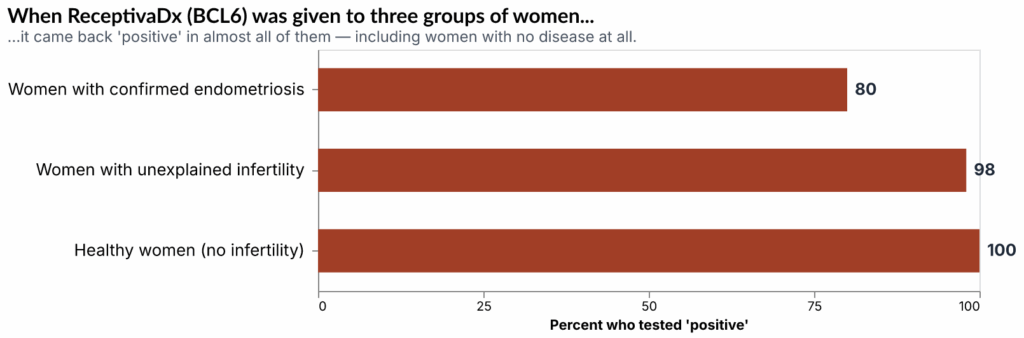
Figure 1. ReceptivaDx measures a marker called BCL6. The problem is not that it misses disease — it is that it calls almost everyone ‘positive,’ including healthy women. In a blinded study, BCL6 came back positive in 80% of women with surgically confirmed endometriosis, 98% of women with unexplained infertility, and 100% of healthy control women with no infertility at all. When a test is positive for nearly everyone regardless of whether they have the disease, a positive result carries almost no information.
The chart above is the clearest picture of why I do not trust ReceptivaDx. When the BCL6 marker was measured in a blinded study, it came back “positive” in 80% of women with confirmed endometriosis, 98% of women with unexplained infertility, and 100% of perfectly healthy women 9. A test that says “positive” to almost everyone — sick or healthy — cannot tell you who actually has the disease. That is a different kind of failure from the blood and saliva tests, which miss real cases; ReceptivaDx’s problem is that it flags nearly everyone.
EndomTest — A Reasonable Idea With a Number Its Marketing Hopes You Skip
What it is. EndomTest (made by Kephera Diagnostics) is a blood test — no biopsy, no surgery. It measures two things in your blood, CA-125 and BDNF, and feeds them, along with some of your clinical history (age, BMI, period history, pain, infertility), into a proprietary computer algorithm that spits out a probability[9]. In other words, it is not really a “blood test.” It is a prediction model that happens to use blood.
The idea behind it — and why each piece is shaky.
- CA-125 has been studied for nearly forty years. The problem is it goes up in a long list of ordinary situations — fibroids, adenomyosis, ovarian cysts, pelvic infection, even a normal period or pregnancy — so on its own it has never been good enough to diagnose endometriosis. The definitive Cochrane review of blood biomarkers found that at the usual cutoff, CA-125 catches only about 40% of true cases[2]. It misses more than half.
- BDNF is the newer, more interesting ingredient — a nerve-growth protein tied to the pain and inflammation of endometriosis, and studies do find it runs higher, on average, in women with the disease[10]. But “higher on average” is not “diagnostic.” When researchers actually tested whether BDNF alone could separate one woman from another, the answer was no — it lacked the sensitivity and specificity needed for a reliable diagnosis[11]. And BDNF is also altered by depression, migraine, obesity, exercise, and chronic stress, so it is a noisy signal.
Combining two imperfect markers with clinical history is a legitimate strategy, and a 2026 meta-analysis confirms that combined models do modestly beat single markers[12]. So the concept is sound. The execution is where you need your eyes open.
Here is the number the marketing glides past. In EndomTest’s own validation study — just 79 women — the test correctly identified only 46% of the women who actually had endometriosis, while its specificity was 100%[9]. The company frames this as a virtue by calling it a “rule-in” test[9], and technically that is honest: if it comes back positive, you very probably do have endometriosis. But flip it over, because that is where you live: a negative EndomTest tells you almost nothing. More than half of women with real endometriosis will be told “negative.” If a negative result makes you or your doctor stop looking, the test has actively harmed you.
What this means for you. EndomTest is also a laboratory-developed test, not FDA approved, validated so far in a very small group of 79 women in which it caught fewer than half of true cases[9]. A positive result might occasionally add confidence in a confusing case. A negative result must never be used to close the book on your symptoms. I would not order it to rule endometriosis out, because it simply cannot do that job — and ruling out is what an anxious patient usually hopes a test will do.
The Ziwig Endotest — The Exciting One, and Exactly Why You Should Stay Calm
This is the test in the headlines: a saliva test for endometriosis that made news when England’s NICE cleared it for limited, conditional NHS use in July 2026[1]. It is genuinely the most scientifically sophisticated of the three, and I want to give it full credit before I give you the cautions.
What it is and why it is clever. You spit into a tube. The lab extracts microRNAs — tiny molecules that act like dimmer switches on your genes — and uses next-generation sequencing plus an artificial-intelligence algorithm to recognize a whole pattern of 100-plus microRNAs associated with endometriosis[13]. Instead of betting on one or two markers, it reads an entire molecular signature. No biopsy. No blood draw. That is a real advance in approach.
The reported performance is eye-popping. The largest validation study, published in 2025, tested 971 women and reported 97% sensitivity and 94% specificity, with an overall accuracy of about 97%[14]. Those are extraordinary numbers for any diagnostic test.
Now the part the headlines leave out — and where you should slow down.
- Whenever a test claims both sensitivity and specificity above 95%, an experienced clinician’s antennae go up, not down. Real diseases in real, messy clinics almost never allow numbers that clean. Extraordinary claims demand extraordinary, independent proof.
- The study was funded by Ziwig, the company that sells the test[14]. That does not make it fraudulent, but it is exactly the situation where independent replication matters most.
- The population was not a normal clinic population. In that validation study, 77% of the participants already had endometriosis[14]. A test looks far better in a group that is mostly sick than it will in a primary-care waiting room where most women with pelvic pain do not have endometriosis. This is a classic reason great study numbers shrink in the real world.
- Independent experts are openly cautious. A 2026 review commissioned by the European Board and College of Obstetrics and Gynaecology noted the signature has essentially only been validated in the country where it was developed, that studies remain small, and that we cannot yet tell whether the saliva pattern reflects endometriosis itself or just the body’s general inflammatory response[15]. Australian specialists reviewing the same test said plainly there is not yet enough real-world data to adopt it — one gynecologist calling it “a probability test… not really designed as a diagnostic test,” at a cost of around $2,000[16].
And read what NICE actually said, not what the headline said. NICE did not approve the Ziwig Endotest as a proven diagnostic. It gave a conditional, three-year recommendation allowing the test in the NHS while more evidence is collected — and stated the tests are “not standalone diagnostic tests,” to be used only in women where endometriosis is still suspected after a normal exam and negative or inconclusive imaging[1]. Their own committee chair acknowledged the evidence base “is still developing” and most studies were done outside the UK, in specialist centers[1]. That is not “the test works.” That is “this is promising enough to study carefully in real life before we trust it.”
One more limitation that no amount of accuracy fixes. Even a perfect saliva test cannot tell you where your endometriosis is, how deep it goes, whether it involves your bowel, bladder, or ureters, or whether you need surgery[16]. For any of that — the information that actually plans your treatment — you still need expert imaging. A positive saliva result does not replace an ultrasound or MRI; it just points you toward one.
The Other Two the Headlines Also Mention — EndoSure and DotEndo
When you read about “new endometriosis tests,” two more names turn up alongside the saliva test. Neither changes the core message of this article — they reinforce it — but you deserve to recognize them if a clinic brings them up.
EndoSure — the one that isn’t blood, saliva, or biopsy. EndoSure shared the same NICE spotlight as the Ziwig saliva test in July 2026, which is why you may have seen the two mentioned in the same breath[17]. It works in a completely different way from anything else here: you fast, then a technician places ECG-style sensor pads on your abdomen and, over about 45 minutes, records the faint electrical signals coming from your gut[17]. The theory is that endometriosis subtly disturbs the electrical rhythm of your digestive muscles, and a computer model reads that disturbance as a “fingerprint”[18]. The company advertises 98–99% accuracy with “no false negatives”[18]. Keep the skepticism you built in Section 4: those numbers rest largely on small, interim, company-linked data — a preprint, not a finished independent trial[18] — and, the detail that should stop you cold, EndoSure’s own US website states the test is “available for research use only and not clinical use” in America[18]. Like the saliva test, NICE gave it only a conditional three-year “use while we collect evidence” status, not a clean bill of approval[17].
DotEndo — the microRNA blood test. DotLab’s DotEndo is a blood test that reads a pattern of endometriosis-linked microRNAs and reports strong accuracy in a study published in a major obstetrics journal[19]. Here is the instructive part: when NICE reviewed all three of these tests together, it recommended the saliva and EndoSure tests for conditional use but declined DotEndo, saying it “requires more research” first[17]. Same category of test, same style of company claim — and even the UK’s cautious clearance body was not persuaded. A newer Canadian blood-microRNA entrant, Afynia (EndomiR), is earlier still: it raised $5 million in seed funding in 2025 and has so far declined to publish its accuracy numbers while it pursues regulatory clearance[20].
What this means for you. A different sample — gut signals, blood, or saliva — does not escape the same trap: an impressive accuracy number from the company that profits from the test, measured in a study population stacked with women who already have the disease, is not proof the test will help you. Notice the pattern across all of them: even the friendliest regulator only cleared any of these conditionally, for continued study, and turned one down outright[17]. The right question never changes: if it’s positive, what changes about my care — and if it’s negative, what has it truly ruled out?
FDA Approved vs. “Lab-Developed” vs. “CE Marked” — Decoding the Fine Print
Patients are often reassured by official-sounding words. Let me translate the three you will see.
- ReceptivaDx and EndomTest are “Laboratory Developed Tests” (LDTs). This means one lab develops, validates, and runs the test in-house — it never goes through independent FDA review of whether it actually helps patients[9]. A CLIA-certified lab is checked for whether it can run the assay accurately and consistently. That is a real quality standard, but it answers a narrow question (“can this lab measure this reliably?”), not the big one (“does a positive result mean what the brochure says?”).
- The Ziwig Endotest carries a European “CE mark” under Europe’s device rules. A CE mark is not FDA approval — it is a European conformity marking, and it is a lower bar than a full clinical-benefit review.
- None of the three is FDA approved for diagnosing endometriosis.
The honest nuance: an LDT is not automatically bad, and FDA approval does not automatically guarantee a test is clinically useful. The only question that ever really matters is the one this whole article keeps circling back to — how strong is the independent clinical evidence? For all three of these tests, the honest answer today ranges from “weak” to “promising but unproven.”
What this means for you. When a clinic hands you a glossy page, look past “FDA,” “CE,” “CLIA,” and “validated.” Ask: Was this checked by people who don’t profit from it? What does a positive result change about my care? What does a negative result actually rule out? If those answers are thin, the official-sounding letters do not save the test.
The Tools Endo Experts Actually Recommend — Expert Ultrasound and MRI
Here is the part the spit-and-saliva headlines bury: we already have non-invasive tests that do something none of the five above can do — they let us see the disease itself, and show us where it is. They are specialist transvaginal ultrasound and pelvic MRI, and for most women they are the right first step.
Why they are different in kind, not just degree. Every test earlier in this article detects a fingerprint — a molecule or a signal that tends to travel with endometriosis. Ultrasound and MRI detect the disease: the ovarian cysts (endometriomas), the nodules, the places where organs have become stuck together. That is why modern guidelines have moved on. The 2022 ESHRE guideline — among the most influential in the world — explicitly stopped treating diagnostic surgery as the required gold standard, recognizing that imaging plus a careful clinical assessment can establish the diagnosis without an operation[21]. A generation ago you needed a laparoscopy to be believed. Today, often, you do not.
How good are they? Genuinely good — with one honest catch.
- A transvaginal ultrasound is the sensible first scan: widely available, low cost, no radiation[22]. In a meta-analysis of 30 studies and more than 4,500 women, expert ultrasound detected deep endometriosis with about 76% sensitivity and 94% specificity — far better than a physical exam alone[23]. For disease pressing on the bowel, skilled sonographers do even better, catching roughly 87% of cases[24]. And for ovarian endometriomas — the cysts — imaging is excellent; MRI identifies them correctly around 96% of the time[25].
- MRI is the second tool, especially before surgery. Across those same 30 studies it detected deep disease with about 82% sensitivity and 87% specificity[23], and it excels at mapping disease deep in the pelvis so a surgeon knows exactly what to expect. As a surgeon, that map — not a probability score from a spit tube — is what I actually operate from.
The honest catch — and it cuts the opposite way from the test-kit marketing. Imaging is powerfully operator-dependent. Its accuracy swings widely depending on who performs and reads the scan; in one 2026 review, reported sensitivity for deep disease ranged from as low as 27% to as high as 98% across studies[22]. A rushed scan by someone without specific endometriosis training can miss a great deal. That is exactly why I keep repeating the word expert: the test is only as good as the person doing it. And even a flawless scan has a limit — very small, superficial surface disease can be invisible on any image, so a normal ultrasound or MRI does not fully rule endometriosis out if your symptoms say otherwise[22].
What this means for you. Before you spend $2,000 on a saliva or gut-signal test, ask whether you have first had a specialist transvaginal ultrasound or MRI performed by someone who images endometriosis for a living. That single step finds most significant disease, tells your surgeon where it is, and usually costs less[16, 22]. The molecular tests, at best, hint at whether to go looking. Imaging shows what is there and where — the information that actually changes your treatment.
So Where Do These Tests Actually Fit? My Honest, Practical Take
Let me put the three side by side in plain language, then tell you how I use them.
- ReceptivaDx (biopsy, BCL6): an old idea whose central claim has not held up under independent, blinded testing[6, 7]. I do not use it as an endometriosis test.
- EndomTest (blood, CA-125 + BDNF + algorithm): a reasonable concept, but it misses about half of true cases in its own study[9]. Occasionally useful as a “rule-in” nudge; useless — and potentially dangerous — as a way to rule endometriosis out.
- Ziwig Endotest (saliva, microRNA + AI): the most impressive science and the most exciting numbers, but company-funded, tested mostly in already-sick populations, not independently replicated across countries, and — by NICE’s own words — allowed only conditionally while evidence is gathered[1, 14].
And underneath all three sits the sobering verdict of the largest independent review ever done. The Cochrane review of 141 studies and more than 15,000 women concluded that no blood biomarker yet has enough accuracy to be used clinically outside of research[2]. The saliva approach is newer and may eventually change that. It has not changed it yet.
Here is where I land, and I want to be clear about it. I do not routinely recommend these tests, and I do not order them for most patients — because a test only earns its place if it changes what we do, and for the vast majority of women, these do not. What actually shortens your journey is not a $2,000 saliva kit; it is being taken seriously, getting a careful history, and being seen by someone who can perform and read a specialist transvaginal ultrasound or MRI[16]. That is the workup that both finds the disease and tells us where it is.
There is a narrow set of situations where I think one of these tests can reasonably be considered — not as an answer, but as a tiebreaker:
- A woman with convincing symptoms whose examination is normal and whose imaging is negative or unclear, who wants more information before deciding about surgery — the exact narrow slot NICE described for the saliva test[1].
- A woman who cannot tolerate or does not want transvaginal ultrasound, for whom a non-invasive first step has genuine value[1].
Even then, the rules are firm: a positive result raises suspicion and points us toward imaging and specialist care; a negative result never overrides your symptoms or closes the case. If your pain is real and a test says “negative,” we keep going. Full stop.
And please do not let a test delay your care. This is the part that worries me most. The most dangerous thing about the hype is not that these tests are imperfect — it is that a woman in pain might spend months and thousands of dollars chasing a “definitive” test instead of starting treatment that could help her now. As one gynecologist put it, the longer pain goes untreated, the harder it becomes to treat[16]. You do not need a confirmed diagnosis to begin managing pain, protecting your fertility, and improving your quality of life. Waiting for the perfect test is often the wrong move.
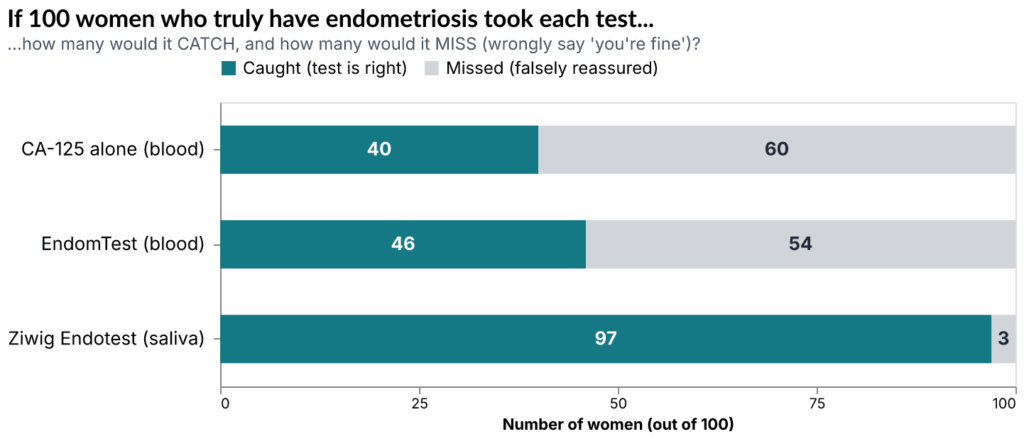
Figure 2. The most important thing a test can do is not miss you. This chart imagines 100 women who really have endometriosis and shows how many each test would correctly catch (dark bar) versus how many it would wrongly tell ‘you’re fine’ (gray bar). CA-125 measured alone catches only about 40 and misses 60. In its own validation study, the EndomTest blood test caught about 46 and missed 54 — more than half — which is why its makers call it a ‘rule-in’ test, not a ‘rule-out’ one. The Ziwig saliva test caught about 97, but in a company-funded study where 77% of the women already had endometriosis, so that number will likely fall in an everyday clinic. A test that misses many real cases can falsely reassure you — which is why a ‘negative’ result should never end the conversation about your symptoms.
The chart above imagines 100 women who truly have endometriosis and asks the question that matters most to you: how many would each test actually catch? CA-125 alone and the EndomTest blood test miss more than half — meaning most women with real disease would be told, wrongly, that they look fine 18,22. The saliva test catches nearly all, but only in a company-funded study where most participants already had the disease, which tends to flatter any test 26,28. The lesson: a test that misses you can be more dangerous than no test at all, because it can stop the search for an answer. (ReceptivaDx is not on this chart on purpose — its failure runs the opposite way. It doesn’t miss cases, it flags nearly everyone, so it belongs on the separate chart back in Section 2 9.)
Before You Pay: 6 Questions to Ask About Any Endometriosis Test
Print this, or screenshot it, and bring it to your appointment. If a clinic cannot answer these clearly, that hesitation is itself your answer.
1. If it comes back positive, what will we actually do differently? A test only earns its cost if it changes your treatment plan.
2. If it comes back negative, what has it truly ruled out? For the blood and saliva tests, a negative can mean almost nothing — more than half of real cases are missed by some of them, so your symptoms still count[2, 9].
3. Who paid for the study behind the accuracy number? Company-funded results, measured in groups where most women already have the disease, tend to look far better than everyday practice[14].
4. Is it FDA approved, or a “lab-developed test”? Ask directly. As explained in Section 6, none of these three carries full FDA approval for diagnosing endometriosis — and official-sounding labels like “CE marked” or “CLIA-certified” are real, but they are lower bars than proof the test actually helps you.
5. Can it tell my surgeon where the disease is? None of them can — only expert transvaginal ultrasound or MRI shows location and guides surgery[16].
6. What does it cost, and would that money be better spent on expert imaging first? A specialist scan is usually cheaper and tells you more — it looks for the disease itself, not just a fingerprint[22].
A Note on Hope, Hype, and Your Wallet
I want to end where I began, with respect for why you are reading this. The dream behind these tests — spit in a tube, end the nine-year wait, be believed — is a good and human dream, and the women quoted in the NICE announcement who finally got answers are not wrong to be grateful[1]. The science of saliva microRNA is real and may well mature into something we all rely on. I am rooting for it.
But rooting for a technology is not the same as recommending you pay for it today. My loyalty is to you, not to the newest product, and the truth today is that none of these three tests can see your disease, none is FDA approved, none can tell your surgeon where to operate[16], and the two American ones miss so many real cases that a “negative” is close to meaningless[6, 9]. Spend your energy and your money on being seen by someone who takes your pain seriously and can image you properly. That, not a test kit, is what ends the wait.
Continue reading: “Endometriosis and Adenomyosis: Two Diseases, One Patient” — how these two conditions overlap, why they are so often missed together, and what that means for your diagnosis and your care.
Sources We Used
So You Can Read Them, Question Them, and Decide for Yourself
We believe that informed patients are empowered patients. In an age where artificial intelligence and open-access science place original research within reach of anyone, you have every right to go to the source, read it yourself, and form your own conclusions. Patient education on this website is taken seriously: we do not simplify at the cost of truth, and we do not ask you to take our word for it.
Every statement in this article carries two layers of accountability. It has been filtered through the critical eye of Dr. Antonio Gargiulo, drawing on four decades of clinical and surgical experience in reproductive medicine and advanced gynecologic surgery. And it is independently traceable to a peer-reviewed scientific publication or official source, listed below, so you can retrieve and read the original at any time.
We see healthcare as a shared responsibility between doctors and patients. Shared responsibility requires shared access to information. These references are not a formality. They are here for you.
- Evans-Hoeker E, Lessey BA, Jeong JW, et al. Endometrial BCL6 Overexpression in Eutopic Endometrium of Women With Endometriosis. Reproductive Sciences. 2016.
- Rambhatla A, Silva C, Asiaii A, et al. Positive Predictive Value of Endometrial BCL6 Overexpression in Patients With Pathology-Confirmed Endometriosis. Fertility and Sterility. 2020.
- Strug M, Aghajanova L, Khan M, et al. Prospective evaluation of mid-luteal endometrial BCL6/SIRT and correlation with outcomes of euploid frozen embryo transfer. 2025.
- Taggar A, Ulrich A, Tan Y, et al. A single biomarker may not yield a reliable binary clinical answer: BCL6 testing and resulting interventions for endometriosis in infertility care. 2025.
- Kosturakis A, Ryan G. Predicting implantation failure: to BCL6 or not to BCL6. Fertility and Sterility. 2022.
- Herranz-Blanco B, Daoud E, Viganò P, García-Velasco JA, Colli E. Development and Validation of an Endometriosis Diagnostic Method Based on Serum Biomarkers and Clinical Variables (EndomTest). Biomolecules. 2023.
- Nisenblat V, Bossuyt PM, Farquhar C, et al. Blood biomarkers for the non-invasive diagnosis of endometriosis. Cochrane Database of Systematic Reviews. 2016.
- Jafarabady K, Shafiee A, Bahri R, et al. Brain-derived neurotrophic factor (BDNF) as a potential marker of endometriosis: a systematic review and meta-analysis. BMC Women’s Health. 2024.
- Perricos A, et al. Increased serum levels of mBDNF in women with minimal and mild endometriosis have no predictive power for the disease. 2018.
- Del Rosario Puling IM, Rahmawan NB, Aisyah VS. Comparative Efficacy of Combined Serum Biomarkers and Clinical Variables for Endometriosis Diagnosis: A Systematic Review and Meta-Analysis. 2026.
- Bendifallah S, Roman H, Suisse S, et al. Validation of a Saliva Micro-RNA Signature for Endometriosis (ENDOmiRNA, funded by Ziwig). NEJM Evidence. 2025.
- Bendifallah S, Suisse S, Puchar A, et al. Salivary MicroRNA Signature for Diagnosis of Endometriosis. Journal of Clinical Medicine. 2022.
- Messinis IE, Messini C, Anifandis G, et al. Salivary miRNAs in the diagnosis of endometriosis (EBCOG invited narrative review). 2026.
- Becker CM, Bokor A, Heikinheimo O, et al. ESHRE guideline: endometriosis. Human Reproduction Open. 2022.
- National Institute for Health and Care Excellence (NICE). Draft early value assessment: technologies for diagnosing endometriosis (EndoSure, Endotest). July 2026.
- Roberts L. Saliva test for endometriosis lacks real-world evidence, Australian experts say (RANZCOG commentary). ABC News. July 2026.
- Noar M, Mathias J, Kolatkar A. Gastrointestinal Myoelectrical Activity (GIMA) Biomarker for Noninvasive Diagnosis of Endometriosis (EndoSure). Journal of Clinical Medicine. 2024.
- Moustafa S, Burn M, Mamillapalli R, et al. Accurate diagnosis of endometriosis using serum microRNAs (DotLab / DotEndo). American Journal of Obstetrics and Gynecology. 2020.
- Lomas N. University spin-out Afynia secures $5M seed to commercialize its microRNA panel test for endometriosis (EndomiR). TechCrunch. 2025.
- Zhang X, Liu D, Huang W, et al. Comparison of physical examination, ultrasound techniques and magnetic resonance imaging for the diagnosis of deep infiltrating endometriosis: a systematic review and meta-analysis. 2020.
- Guerriero S, Ajossa S, Orozco R, et al. Accuracy of transvaginal ultrasound for diagnosis of deep endometriosis: systematic review and meta-analysis. 2015.
- Qureshi A, et al. MRI Versus Histopathology: Evaluating Diagnostic Accuracy in Detecting Endometrioma. 2025.
- Batool F, et al. Diagnostic Accuracy of Trans-Vaginal Ultrasound for Deep Infiltrative Endometriosis: A Systematic Review. 2026.
References
1. Embargoed: New technologies could help cut years-long wait for endometriosis diagnosis, says NICE. https://nice-newsroom.prgloo.com/news/embargoed-new-technologies-could-help-cut-years-long-wait-for-endometriosis-diagnosis-says-nice
2. Nisenblat V, Bossuyt P, Shaikh R, et al (2016) Blood biomarkers for the non-invasive diagnosis of endometriosis. Cochrane Database of Systematic Reviews. https://doi.org/10.1002/14651858.CD012179
3. ESHRE guideline: endometriosis. https://pubmed.ncbi.nlm.nih.gov/35350465/
4. Rambhatla A, Silva C, Asiaii A, et al (2020) POSITIVE PREDICTIVE VALUE OF ENDOMETRIAL BCL6 OVEREXPRESSION IN PATIENTS WITH PATHOLOGY-CONFIRMED ENDOMETRIOSIS. Fertility and Sterility. https://doi.org/10.1016/j.fertnstert.2020.02.092
5. Evans-Hoeker E, Lessey B, Jeong J-W, et al (2016) Endometrial BCL6 Overexpression in Eutopic Endometrium of Women With Endometriosis. Reproductive Sciences. https://doi.org/10.1177/1933719116649711
6. Strug M, Aghajanova L, Khan M, et al (2025) Prospective evaluation of mid-luteal endometrial BCL6/SIRT and correlation with outcomes of euploid frozen embryo transfer: a prospective cohort study. Journal of Assisted Reproduction and Genetics. https://doi.org/10.1007/s10815-025-03558-7
7. Taggar A, Ulrich A, Tan Y, et al (2025) A single biomarker may not yield a reliable binary clinical answer: B cell lymphoma 6 testing and resulting interventions for endometriosis in infertility care. F&S Reports. https://doi.org/10.1016/j.xfre.2025.11.005
8. Kosturakis A, Ryan G (2022) Predicting implantation failure: to BCL6 or not to BCL6. Fertility and Sterility. https://doi.org/10.1016/j.fertnstert.2021.12.021
9. Development and Validation of an Endometriosis Diagnostic Method Based on Serum Biomarkers and Clinical Variables. https://pubmed.ncbi.nlm.nih.gov/37509088/
10. Jafarabady K, Shafiee A, Bahri R, et al (2024) Brain-derived neurotrophic factor (BDNF) as a potential marker of endometriosis: a systematic review and meta-analysis. BMC Women’s Health. https://doi.org/10.1186/s12905-023-02877-0
11. Perricos A, Ashjaei K, Husslein H, et al (2018) Increased serum levels of mBDNF in women with minimal and mild endometriosis have no predictive power for the disease. Experimental biology and medicine. https://doi.org/10.1177/1535370217742600
12. Puling IMDR, Rahmawan NB, Aisyah VS (2026) Comparative Efficacy of Combined Serum Biomarkers and Clinical Variables for Endometriosis Diagnosis: A Systematic Review and Meta-Analysis. Asian Journal of Health Research. https://doi.org/10.55561/ajhr.v5i1.317
13. Bendifallah S, Suisse S, Puchar A, et al (2022) Salivary MicroRNA Signature for Diagnosis of Endometriosis. Journal of Clinical Medicine. https://doi.org/10.3390/jcm11030612
14. Bendifallah S, Roman H, Suisse S, et al (2025) Validation of a Saliva Micro-RNA Signature for Endometriosis. NEJM Evidence. https://doi.org/10.1056/EVIDoa2400195
15. Messinis IE, Messini C, Anifandis G, et al (2026) Salivary miRNAs in the diagnosis of endometriosis An invited narrative scientific literature review, commissioned by European Board and College of Obstetrics and Gynaecology (EBCOG). European Journal of Obstetrics, Gynecology, and Reproductive Biology. https://doi.org/10.1016/j.ejogrb.2026.115261
16. Saliva test for endometriosis lacks real-world evidence, Australian experts say – ABC News. https://www.abc.net.au/news/health/2026-07-29/ziwig-endotest-endometriosis-australia-france-uk-health/106910202
17. NICE recommends Endosure and Endotest diagnostics for endometriosis | Fierce Biotech. https://www.fiercebiotech.com/medtech/nice-recommends-endosure-and-endotest-diagnostics-endometriosis
18. EndoSure Inc.: Endometriosis Diagnosis Testing Device. https://www.endosure.com/
19. DotLab | Information about DotEndo for Clinicians. https://www.dotlab.com/clinicians
20. Consortium S University spin-out Afynia secures $5M seed to commercialize its microRNA panel test for endometriosis – Synapse Life Science Consortium. https://synapseconsortium.com/university-spin-out-afynia-secures-5m-seed-to-commercialize-its-microrna-panel-test-for-endometriosis/
21. PMC E ESHRE guideline: endometriosis. – Abstract – Europe PMC. https://europepmc.org/article/MED/35350465
22. Batool F, Khan J, Farooq SMY, et al (2026) Diagnostic Accuracy of Trans-Vaginal Ultrasound for Deep Infiltrative Endometriosis: A systematic review. Hellenic Journal of Obstetrics and Gynecology. https://doi.org/10.33574/hjog.0620
23. Zhang X, He T, Shen W (2020) Comparison of physical examination, ultrasound techniques and magnetic resonance imaging for the diagnosis of deep infiltrating endometriosis: A systematic review and meta-analysis of diagnostic accuracy studies. Experimental and Therapeutic Medicine. https://doi.org/10.3892/etm.2020.9043
24. Guerriero S, Alcázar J, Ajossa S, et al (2015) OC16.04: Diagnostic accuracy of transvaginal ultrasound for diagnosis of deep endometriosis: systematic review and meta‐analysis. Ultrasound in Obstetrics & Gynecology. https://doi.org/10.1002/UOG.15052
25. Qureshi A, Iqbal J, Shah S, et al (2025) MRI Versus Histopathology: Evaluating Diagnostic Accuracy in Detecting Endometrioma. Cureus. https://doi.org/10.7759/cureus.88713