

All information is based on current medical research (2018–2026). Written specifically for patient education by Dr. Antonio Gargiulo. This article does not replace a consultation with your gynecologist or healthcare provider.
What Is ENDO-205, and Why Is Everyone Talking About It?
If you follow endometriosis news, you have probably seen the headlines: a brand-new drug called ENDO-205, the “first non-hormonal treatment for endometriosis,” has been cleared to begin human testing. For a disease that has been treated for decades with the same two tools — hormones to quiet the symptoms and surgery to remove the tissue — that sounds like the beginning of something big[1].
And it might be. But here is the part the headlines usually leave out: ENDO-205 is not a treatment you can get. Not this year, and almost certainly not for many years. In March 2026, the U.S. Food and Drug Administration (FDA) gave the company permission to start testing the drug in people[1]. That is a real milestone — but it is the starting line of a very long race, not the finish line[2].
Think of it like a promising college athlete who just got drafted. Getting drafted is genuinely exciting and hard to do. But it is not the same as winning a championship, and most drafted players never do. A new drug works the same way: most drugs that reach this point never make it to patients[3]. So this article has two jobs: to explain honestly what ENDO-205 (and a handful of other new non-hormonal drugs) actually is, and to make sure that excitement about the future does not pull you away from the treatments that can help you today. The message I want you to leave with is simple: hope for the future, care for today.
What Exactly Is ENDO-205?
ENDO-205 is being developed by a company called EndoCyclic Therapeutics. It belongs to a class of drugs called precision peptides — a peptide is just a very small protein, and “precision” means it is engineered to act only in one specific place[1].
Here is the idea in plain terms. The drug is designed to seek out endometriosis lesions and act only inside that diseased tissue, while leaving your healthy tissue alone[1]. In laboratory and animal studies, the company reported that the drug made endometriosis lesions disappear and calmed the inflammation around them, without any safety warning signs in the required animal toxicity tests[1].
Why is this different from what we have now? Almost every medicine we currently use for endometriosis works by lowering your hormones — especially estrogen — to starve the tissue and quiet the pain. That includes birth control pills, progestins, and drugs like Lupron, Orilissa, and Myfembree[2]. These can genuinely help with pain, but they do not remove the lesions, and when you stop taking them the symptoms often come back[1]. ENDO-205 is meant to do something none of the hormone drugs do: target the disease itself, without turning your hormones off and without surgery[1].
That is a genuinely exciting concept. It is also, right now, exactly that — a concept that worked in animals and now has to prove itself in people[2].
What Did the FDA Actually Do? (Less Than the Headlines Suggest)
This is the single most misunderstood part of the story, so let me be very clear.
The FDA did not approve ENDO-205. It did not say the drug works, and it did not say the drug is safe for patients. What the FDA cleared is something called an Investigational New Drug application, usually shortened to IND[2].
An IND is basically a permission slip. It says: the company has shown us enough laboratory and animal safety data that we will allow them to begin testing this drug in humans. That is all it means[2]. The first human study — called Phase 1 — will enroll healthy women, and its main goal is to check safety, not to prove the drug works[1, 2].
So when you read “FDA clears ENDO-205,” here is the accurate translation: the drug is now allowed to begin the very first, smallest, safety-only human study. It is not available to patients, and it has not yet been shown to work in a single human being[2].
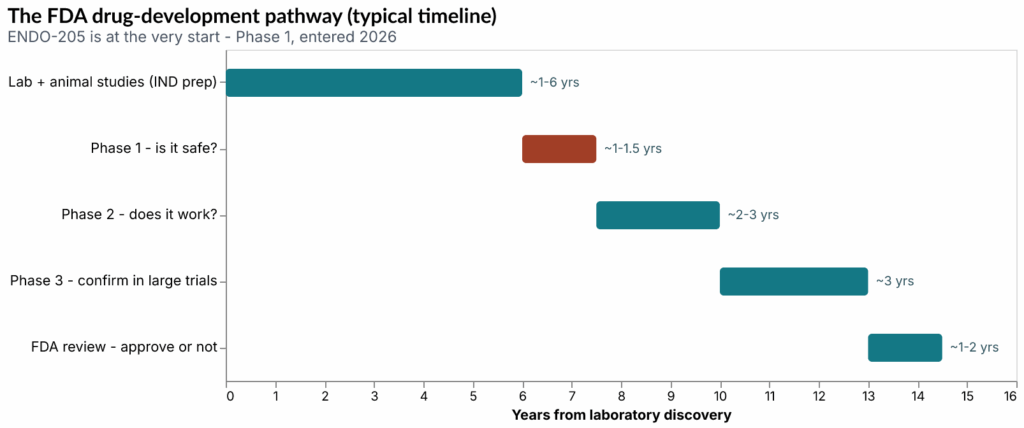
Figure 1. A drug does not go from discovery to your medicine cabinet quickly. After laboratory and animal studies, a company files an Investigational New Drug (IND) application; FDA clearance lets it begin human testing. Phase 1 checks safety, Phase 2 asks whether it works, Phase 3 confirms it in large trials, and only then does the FDA review it for approval. From the start of Phase 1 to approval typically takes 6-13 years, and from first lab discovery 10-15 years. ENDO-205 received FDA IND clearance in March 2026 and is entering Phase 1 – the very beginning of this road.
How New Drugs Are Really Made — and Why It Takes So Long
To understand where ENDO-205 sits, it helps to know the road every drug has to travel. It goes in order, one step at a time, and each step can take years.
- Step 1 — Laboratory and animal studies. Scientists test the idea in cells and animals. If it looks promising and safe, the company files the IND.
- Step 2 — Phase 1 (Is it safe in people?). A small group of volunteers takes the drug so researchers can watch for side effects and figure out safe doses. This is where ENDO-205 is now.
- Step 3 — Phase 2 (Does it actually work?). A larger group of patients with the disease takes the drug to see whether it truly helps. This is the hardest step to pass — in recent data, fewer than one in three drugs made it through this stage[3].
- Step 4 — Phase 3 (Prove it in large trials). Hundreds or thousands of patients are studied, often comparing the drug against a placebo, to confirm it works and is safe.
- Step 5 — FDA review. Only after all of that does the FDA decide whether to approve the drug for real patients.
Now the two numbers that matter most, and that no honest article should skip.
First, how long it takes. From the start of Phase 1 to a possible approval usually takes 6 to 13 years, and from the first lab discovery, closer to 10 to 15 years[4]. Even in a best-case, everything-goes-right scenario, a drug entering Phase 1 today is realistically many years — think 6 to 10 or more — from a pharmacy shelf[2].
Second, how often it fails. This is the hard truth. Of all the drugs that begin Phase 1 testing, only about 8% are ever approved by the FDA — meaning more than 90% never make it[3]. For chronic, common diseases like endometriosis, the odds are even a little lower, around 6%[3]. Looking at all drugs that enter human trials, only around 1 in 8 reaches approval[4].
I am not telling you this to be discouraging. I am telling you because it is the truth, and because it lets you read the next exciting headline with clear eyes. A drug entering Phase 1 has crossed a real and difficult threshold — and it still, statistically, is far more likely to fail than to succeed[3, 4].
ENDO-205 Is Not Alone — What Else Is in the Pipeline
Here is some genuinely good news that the ENDO-205 headlines miss: it is part of a whole wave of new non-hormonal ideas being tested for endometriosis. This matters, because women who cannot take hormones — because of side effects, other medical conditions, or because they are trying to get pregnant — have been badly underserved for a long time[5]. A few of the most notable programs, each at a different point on the road:
- HMI-115 (from a company called Hope Medicine) is the furthest along of any non-hormonal endometriosis drug — it is the first and only one to reach Phase 3, the final testing stage[6]. It is an antibody that blocks a hormone-signaling pathway involving prolactin, and in its Phase 2 trial (published in The Lancet) it significantly reduced moderate-to-severe pain without shutting down the body’s main sex hormones[6]. It has earned “Fast Track” status from the FDA[6].
- Vipoglanstat (from Gesynta Pharma) is a non-hormonal, non-opioid pill that targets an enzyme driving inflammation and pain in lesions. It is in Phase 2, with results expected in 2027[7].
- The quinagolide vaginal ring is an important cautionary tale. It reached a Phase 2 trial — and then, when tested carefully against a placebo, it did not shrink lesions any better than the placebo did[8]. This is exactly why we run trials: promising ideas often do not pan out, and only real testing tells us which ones are worth pursuing.
- Dichloroacetate (DCA) is an old, repurposed drug that changes how lesion cells use energy. It is at a very early, feasibility stage of testing in women with endometriosis[9].
Notice how spread out these are. One is in Phase 3, two are in Phase 2, one already stumbled, and ENDO-205 is just entering Phase 1. That range is the whole point of the picture below.
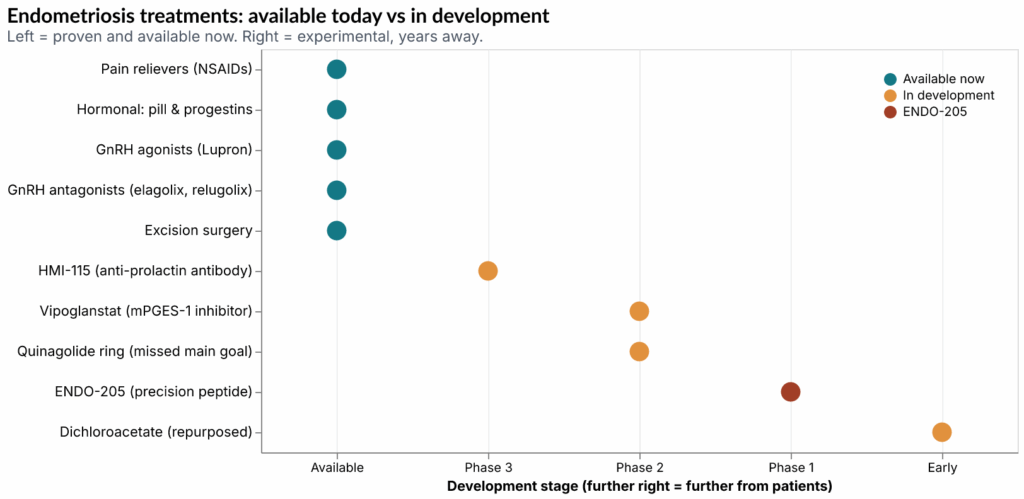
Figure 2. Today’s proven treatments (left) are available now: pain relievers, hormonal therapies (the pill, progestins, GnRH agonists such as Lupron, and GnRH antagonists such as elagolix and relugolix), and excision surgery. The non-hormonal drugs in development (right) sit at different, earlier stages: HMI-115, an anti-prolactin antibody, is the only one in Phase 3; vipoglanstat, an anti-inflammatory mPGES-1 inhibitor, is in Phase 2; the quinagolide vaginal ring reached Phase 2 but missed its main goal; dichloroacetate is at an early feasibility stage; and ENDO-205 is just entering Phase 1. The further right a treatment sits, the more years and uncertainty stand between it and your pharmacy.
Where Would ENDO-205 Fit — and What Should You Do Right Now?
What this means for you: If ENDO-205 eventually proves safe and effective — and that is a big “if” that is 6 to 10 or more years away — it would be a new option added to the menu, not a replacement for everything we have today[2]. It would be especially meaningful for women who cannot use hormones or who keep having lesions come back after surgery[5]. That is a future genuinely worth being hopeful about.
But hope for the future is not a treatment for today. Right now, you have real, proven tools: hormonal therapy to control pain, and skilled excision surgery to remove disease. Endometriosis is a progressive condition for many women — waiting years for an experimental drug that may never arrive, while your pain and lesions go untreated, is not a neutral choice. It can cost you fertility, function, and quality of life you do not get back[1, 2].
So my advice is the same thing I tell my own patients when they bring me a headline:
- Be excited. This wave of non-hormonal research is the most encouraging thing to happen in endometriosis treatment in a long time.
- Be patient and realistic. IND clearance is a starting line, most drugs that start this race do not finish, and the ones that do take many years[3, 4].
- Do not put your life on hold. Get evaluated, treat your disease with what works now, and protect your fertility and function while the science matures. If a promising drug does arrive in ten years, you want to arrive at that day as healthy as possible.
Hope for the future. Care for today. You deserve both.
A Note on Reading the Headlines
The people writing exciting drug-announcement articles are not usually trying to mislead you — but a company press release exists to generate excitement, and a news headline exists to get clicks. Neither is written to help you make a medical decision. When you see the next “breakthrough” story, ask three plain questions: Is it approved, or just being tested? What phase is it in? And is it available to me today? For ENDO-205, the honest answers are: not approved, Phase 1, and no[2]. That does not make it any less worth cheering for. It just means you should keep cheering from a place of good, ongoing care — not from a waiting room where you are putting off treatment for something that may be a decade away.
Continue reading: “Endometriosis and Adenomyosis: Two Diseases, One Patient” — how these two conditions overlap, why they are so often missed together, and what that means for your care.
Sources We Used
So You Can Read Them, Question Them, and Decide for Yourself
We believe that informed patients are empowered patients. In an age where artificial intelligence and open-access science place original research within reach of anyone, you have every right to go to the source, read it yourself, and form your own conclusions. Patient education on this website is taken seriously: we do not simplify at the cost of truth, and we do not ask you to take our word for it.
Every statement in this article carries two layers of accountability. It has been filtered through the critical eye of Dr. Antonio Gargiulo, drawing on four decades of clinical and surgical experience in reproductive medicine and advanced gynecologic surgery. And it is independently traceable to a peer-reviewed publication or primary source, listed below, so you can retrieve and read the original at any time.
We see healthcare as a shared responsibility between doctors and patients. Shared responsibility requires shared access to information. These references are not a formality. They are here for you.
- EndoCyclic Therapeutics. FDA Clearance of Investigational New Drug (IND) Application for ENDO-205, a First-in-Class Non-Hormonal Precision Peptide Therapeutic for Endometriosis. Company press release (via BioSpace / PR Newswire). March 23, 2026.
- Tia. ENDO-205: The New Non-Hormonal Endometriosis Treatment Entering Clinical Trials. Patient-education article. April 23, 2026.
- Hope Medicine. Phase III Trial Initiation for HMI-115, a First-in-Class Non-Hormonal Endometriosis Treatment (Phase II results published in The Lancet Obstetrics, Gynaecology & Women’s Health). Company announcement via MedPath, 2026.
- Gesynta Pharma. Phase 2 (NOVA) Trial of Vipoglanstat, a Non-Hormonal mPGES-1 Inhibitor for Endometriosis. Company press release (via PR Newswire). June 17, 2026.
- Ferring / QLARITY investigators. Quinagolide vaginal ring for reduction of endometriotic lesions: results from the QLARITY trial. Randomized, double-blind, placebo-controlled Phase 2 trial. ClinicalTrials.gov NCT03749109.
- EPiC investigators. Dichloroacetate as a possible treatment for endometriosis-associated pain (EPiC): a single-arm, open-label exploratory clinical trial. ClinicalTrials.gov NCT04046081.
- Non-Hormonal Strategies in Endometriosis. Review of non-hormonal therapeutic approaches. PMC (National Library of Medicine). 2025.
- Biotechnology Innovation Organization (BIO), Informa Pharma Intelligence & QLS Advisors. Clinical Development Success Rates and Contributing Factors 2011–2020.
- ClinicalMetric. How Long Do Clinical Trials Take? Timeline for All Phases. Industry analysis of clinical-trial durations and approval rates.
References
1. EndoCyclic Therapeutics Announces FDA Clearance of Investigational New Drug (IND) Application for ENDO-205, a First-in-Class Non-Hormonal Precision Peptide Therapeutic for Endometriosis – BioSpace. https://www.biospace.com/press-releases/endocyclic-therapeutics-announces-fda-clearance-of-investigational-new-drug-ind-application-for-endo-205-a-first-in-class-non-hormonal-precision-peptide-therapeutic-for-endometriosis
2. New Non-Hormonal Endometriosis Treatment Enters Clinical Trials – Tia. https://asktia.com/article/endo-205-new-non-hormonal-endometriosis-treatment/
3. [PDF] Clinical Development Success Rates and Contributing Factors 2011–2020. https://go.bio.org/rs/490-EHZ-999/images/ClinicalDevelopmentSuccessRates2011_2020.pdf
4. Systems CI How Long Do Clinical Trials Take? Timeline for All Phases | ClinicalMetric. https://clinicalmetric.com/insights/clinical-trial-duration-timeline
5. Non-Hormonal Strategies in Endometriosis – PMC – NIH. https://pmc.ncbi.nlm.nih.gov/articles/PMC12295211/
6. Trial M Hope Medicine Initiates Phase III Trial for First-in-Class Non-Hormonal Endometriosis Treatment – MedPath Trial. https://trial.medpath.com/news/hope-medicine-initiates-phase-iii-trial-for-first-in-class-non-hormonal-endometriosis-treatment
7. Pharma G Gesynta Pharma Randomizes 50% of Patients in Phase 2 Endometriosis Trial of Vipoglanstat. https://www.prnewswire.com/news-releases/gesynta-pharma-randomizes-50-of-patients-in-phase-2-endometriosis-trial-of-vipoglanstat-302802929.html
8. Quinagolide vaginal ring for reduction of endometriotic lesions: Results from the QLARITY trial – PubMed. https://pubmed.ncbi.nlm.nih.gov/40188683/
9. Dichloroacetate as a possible treatment for endometriosis-associated pain: a single-arm open-label exploratory clinical trial (EPiC) – PubMed. https://pubmed.ncbi.nlm.nih.gov/33712086/