
All information is based on current medical research (2018–2026). Written specifically for patient education by Dr. Antonio Gargiulo (advanced endometriosis surgery) and Dr. Melanie Kappadakunnel (gastroenterology). This article does not replace a consultation with your gynecologist, gastroenterologist, or healthcare provider.
The Patient Who Has Already Been Everywhere
By the time many women reach one of our offices, they arrive with a thick folder. Years of belly pain and bowel trouble. A diagnosis of “IBS” handed out somewhere along the way. And a growing suspicion — usually correct — that nobody has put the whole picture together.
One of us (Dr. Gargiulo) spends his days treating endometriosis, including disease that grows into and around the bowel. The other (Dr. Kappadakunnel) spends her days sorting out which abdominal pain is coming from the gut itself and which is coming from somewhere else. We see the same women from two directions, and we wrote this together because the biggest mistakes we see happen in the gap between our two specialties.
This article answers one specific question: how do you tell whether your bowel symptoms are irritable bowel syndrome, endometriosis, or both? (A companion article tackles the next question — why the common tests, especially a “normal” colonoscopy, so often get it wrong)
Here is the single most important idea to carry with you: endometriosis and gut disorders like IBS are not rivals — they travel together, constantly. Being told you have IBS does not mean you don’t also have endometriosis. Most of the time, the honest answer is “some of both.”
Two Conditions That Speak the Same Language
Here is the core problem. Endometriosis and common gut disorders produce almost the same complaints: lower belly pain, bloating, cramping, constipation, diarrhea, pain with bowel movements. If you just read a symptom list, you often cannot tell them apart.
That overlap has a real human cost. Women with endometriosis wait, on average, up to about 10 years for a correct diagnosis; roughly two-thirds are misdiagnosed along the way, and nearly half are seen by five or more physicians before someone gets it right[1]. Up to 90% of patients with endometriosis experience a variety of both upper and lower GI symptoms Endometriosis and healthcare utilization is very high. The delay in care is longest for women whose main complaint is pain rather than trouble conceiving[1]. A great many of those detours run straight through a gastroenterology clinic, because the abdomen is where the symptoms are loudest.
Up to 90% of women with endometriosis report symptoms that a gastroenterologist would recognize instantly from her IBS patients — abdominal pain, bloating, and changing bowel habits[2]. So the confusion is not anyone’s fault. It is built into the biology.
At the table: Antonio & Melanie
Melanie (gastroenterologist): When a young woman comes to me with pain, bloating, and irregular bowels, IBS is genuinely one of the most common things I see — so it’s a reasonable first thought, not a lazy one. My job is to make sure I don’t stop there. There can be so many other conditions that mimic IBS including but not limited to: celiac disease, H pylori bacteria, inflammatory bowel disease such as crohn’s disease or ulcerative colitis, gut dysbiosis, AND endometriosis.
Antonio (endometriosis surgeon): And when that same woman comes to me, I’m biased the other way — I see endometriosis all day, so I have to guard against calling everything endo. The trap for both of us is the same: treating “IBS” and “endometriosis” as an either/or. In this patient it’s usually a both, and the interesting question is the proportion.
What this means for you: If you were handed an IBS label and it never fully explained your pain — especially pain that tracks your menstrual cycle — that instinct is worth taking seriously. It does not mean the IBS diagnosis was wrong. It means it may not be the whole story.
How Often Do They Actually Travel Together?
This is where the numbers are genuinely striking, and they come from good-quality studies.
When researchers pooled many studies together, women with endometriosis had roughly three times the odds of also having irritable bowel syndrome compared with women without endometriosis — a meta-analysis of 17 studies and more than 96,000 women found the odds about 2.97 times higher[3]. A second independent meta-analysis landed in the same place, with the odds a little over three times higher[4], and a third put the increased risk at about two-to-three-fold[5]. Put plainly: about one in four women with endometriosis also meets criteria for IBS (pooled prevalence roughly 23%, with individual studies ranging widely from about 11% to 52%)[3].
The link also runs forward in time. In a nationwide study of more than 6,000 women in Taiwan followed for five years, those with endometriosis were about 1.8 times more likely to be newly diagnosed with IBS than women without it — and the risk was highest in the first year after diagnosis[6]. Clinicians who work in this space estimate the two conditions coexist in up to 60% of patients, meaning whichever clinic you are sitting in, there is a good chance your other problem is being undertreated[2].
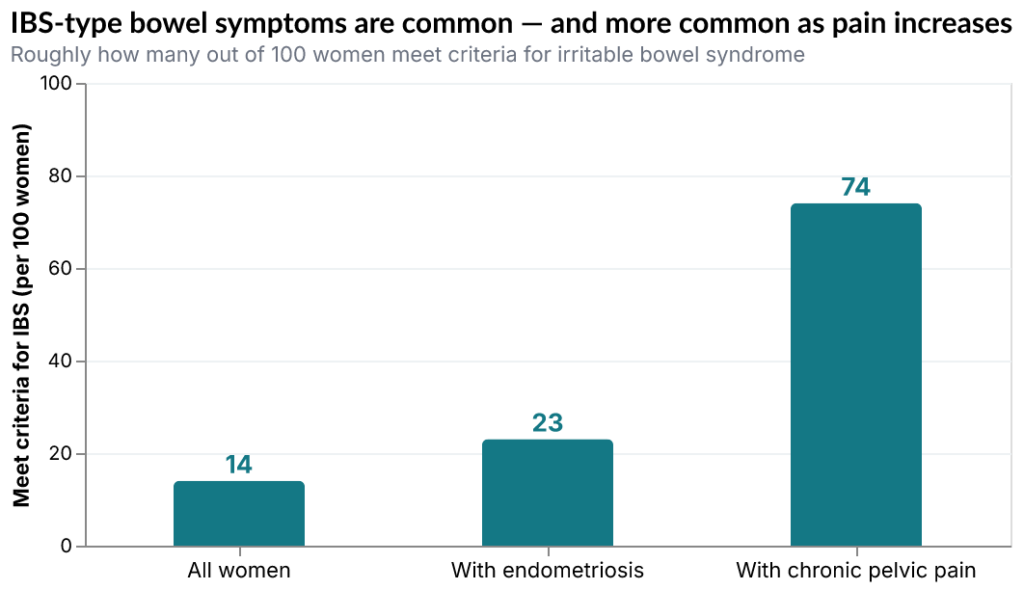
Figure 1. IBS-type bowel symptoms are common in women generally (about 14%), more common in women with endometriosis (pooled ~23%), and very common in women with chronic pelvic pain (about 74%) — which is why bowel symptoms alone cannot tell endometriosis and IBS apart.
But here is the honest twist, and it is important. A 2025 British study of women having surgery for chronic pelvic pain found that IBS-type symptoms were extremely common — about 74% of them met the criteria — but, counterintuitively, IBS symptoms were more common in the women who turned out not to have endometriosis, and women with the deepest endometriosis were the least likely to fit the IBS pattern[7]. In other words, IBS is not simply “endometriosis in disguise.” It is a real, common, separate condition that also happens to travel in the same crowd. The takeaway the authors drew is one we both endorse: every woman with chronic pelvic pain should have her bowel symptoms taken seriously in their own right[7].
At the table: Antonio & Melanie
Antonio: This is the study that keeps me humble. I’d love to tell every pelvic-pain patient “it’s the endo,” but the data say plenty of them have genuine IBS on top of it — or instead of it.
Melanie: Right — and that cuts both ways. If I “cure” someone’s IBS and a third of her pain remains, that leftover pain is a signal, not a failure. It’s often the part that belongs to Antonio. Many times though, IBS pain and endometriosis pain can both become a chronic type of pain and it is difficult to reconcile that idea as someone in our positions trying to treat a condition– especially when both of those conditions’ symptoms overlap.
Why the Symptoms Overlap — the Body’s Wiring
Why would misplaced uterine tissue and a “functional” gut disorder feel the same? The answer is one of the more elegant pieces of pain science, and it is worth understanding because it changes how you think about your own body.
Your pelvic organs share wiring. The bladder, bowel, uterus, and vagina send their pain signals through overlapping nerve pathways. When one inflamed organ keeps firing, it can effectively turn up the volume on its neighbors — a phenomenon called cross-organ sensitization. Over time the whole system can become oversensitive, so that normal signals (a bowel filling with gas, a period starting) are felt as pain. Researchers describe endometriosis pain as a product of this peripheral, central, and cross sensitization, not just the lesions themselves[8].
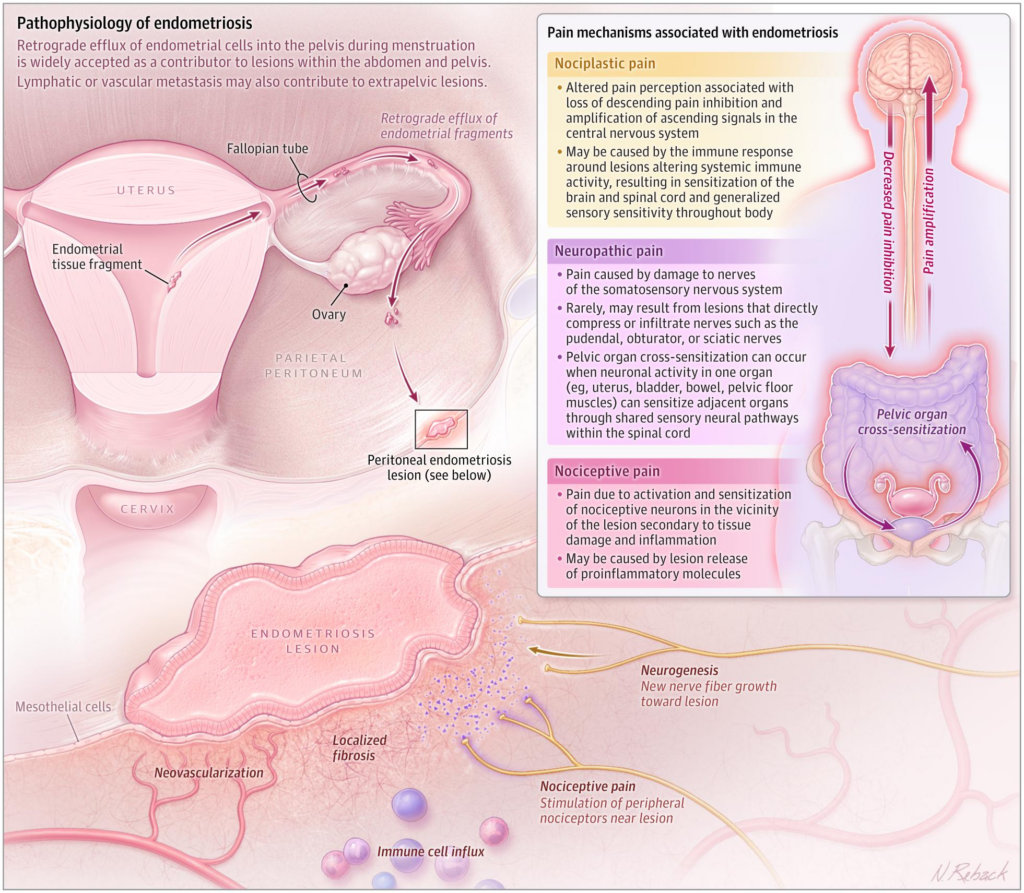
This explains one of the most confusing facts patients are told: the amount of pain does not match the amount of disease. A landmark study measured how sensitive the gut was in women with endometriosis and found visceral hypersensitivity was extremely common — IBS-type symptoms appeared in about 65% of women with mild endometriosis and 50% with severe disease, versus none of the healthy controls, and their pain thresholds were markedly lower[9]. The authors concluded this “might explain why mildly affected individuals often complain of severe symptoms out of proportion to the extent of their disease”[9]. Modern reviews agree that endometriosis pain correlates poorly with the extent of visible disease[8].
That principle even holds inside the bowel. When surgeons examined 553 women with bowel endometriosis, they found no meaningful relationship between how deep the disease had burrowed into the bowel wall and how bad the symptoms were[10]. A small, shallow lesion can scream; a large, deep one can whisper. Interestingly, the same holds true in the world of gastroenterology, specifically in regards to inflammatory bowel disease, such as ulcerative colitis or Crohn’s disease in which the presence of symptoms do not always correlate with active disease, nor does the absence of symptoms correlate with controlled inflammation.
What this means for you: If a doctor has ever implied your pain is exaggerated because your imaging looks “only mild,” the science is on your side, not theirs. In endometriosis, symptom severity and disease size routinely disagree.
The Red Flags — When Bowel Symptoms Are Really Endometriosis
If the symptoms overlap so much, how does a good clinician decide when to suspect endometriosis behind a “gut” problem? The most useful clue is a single word: cyclic.
Endometriosis tissue responds to your hormones the way the lining of your uterus does — it swells and bleeds around your period. So endometriosis in or near the bowel tends to produce symptoms that rise and fall with your menstrual cycle: cramping, constipation, or diarrhea that clusters around your period, pain with bowel movements during menstruation, and — the most specific red flag of all — cyclic rectal bleeding (bleeding from the rectum that shows up with your period, known medically as catamenial hematochezia).
Other clues point toward endometriosis rather than a primary gut disorder: painful periods severe enough to disrupt life (dysmenorrhea), deep pain with intercourse (dyspareunia), difficulty conceiving, and symptoms that steadily worsen over years rather than flaring and settling at random.
At the table: Antonio & Melanie
Melanie: These are the flags that make me pick up the phone and call Antonio instead of just reaching for another IBS prescription. If a woman tells me her bowel symptoms have a calendar — worse every period — that’s not classic IBS. IBS doesn’t usually read a menstrual calendar.
Antonio: And cyclic rectal bleeding is the one nobody should ever wave away. It’s uncommon, but when it’s there, it’s endometriosis until proven otherwise — and proving it is a story of its own, because the test most people expect to catch it usually doesn’t.
What this means for you: Keep a simple symptom-and-period diary for two or three months before your appointment. If your bowel symptoms line up with your cycle, bring that pattern to the visit and say so out loud. It is one of the most valuable things you can hand either of us.
Our Take: Stop Treating It as an Either/Or
After all of this, here is where the two of us land, together.
Stop treating “IBS” and “endometriosis” as an either/or. The evidence is overwhelming that they coexist far more often than chance, share the same nerve wiring, and produce the same complaints[2, 3]. If you have been given one label and it doesn’t explain everything, the missing piece is frequently the other diagnosis — not a personal failing, and not “all in your head.”
Respect the calendar. Bowel symptoms that track your menstrual cycle, and cyclic rectal bleeding above all, should trigger a search for endometriosis even if a routine gut work-up came back “normal”[8].
Treat the gut problem and endometriosis. If you genuinely have IBS alongside endometriosis, treating it helps — but it is not a reason to stop looking for, or treating, the disease that surgery and hormonal therapy can actually address.
And once endometriosis is genuinely suspected, the next question becomes: how do you actually find it? That is where a lot of women get falsely reassured — and it is the subject of the companion article.
A Note on Being Believed
If there is a single thread running through this article, it is this: women with pelvic and bowel pain are too often bounced between clinics, handed a label, and sent away — and the average of a decade to diagnosis is the price of that fragmentation[1]. You are allowed to ask for more. You are allowed to say, “My gut work-up was normal, but my symptoms follow my period — what could that mean?” You are allowed to ask your gynecologist and your gastroenterologist to actually talk to each other.
Good medicine here is not one brilliant specialist. It is two ordinary specialists who bother to compare notes. That is the care we would want for our own families, and it is the care you should expect.
Continue reading: “A Normal Colonoscopy Didn’t Rule Out Endometriosis — Here’s What Actually Finds It” — why the test most women expect to catch bowel endometriosis misses it more than 90% of the time, and which tests actually map the disease.
Sources We Used
So You Can Read Them, Question Them, and Decide for Yourself
We believe that informed patients are empowered patients. In an age where artificial intelligence and open-access science place original research within reach of anyone, you have every right to go to the source, read it yourself, and form your own conclusions. Patient education on this website is taken seriously: we do not simplify at the cost of truth, and we do not ask you to take our word for it.
Every statement in this article carries two layers of accountability. It has been filtered through the combined clinical judgment of Dr. Antonio Gargiulo, drawing on four decades of experience in reproductive medicine and advanced gynecologic surgery, and Dr. Melanie Kappadakunnel, in gastroenterology. And it is independently traceable to a peer-reviewed publication or primary source, listed below, so you can retrieve and read the original at any time.
We see healthcare as a shared responsibility between doctors and patients — and, when the problem crosses specialties, a shared responsibility between doctors and each other. Shared responsibility requires shared access to information. These references are not a formality. They are here for you.
1. Nabi M, Nauhria S, Reel M, et al. Endometriosis and irritable bowel syndrome: A systematic review and meta-analyses. Frontiers in Medicine. 2022. DOI: 10.3389/fmed.2022.914356
2. Chiaffarino F, Cipriani S, Ricci E, et al. Endometriosis and irritable bowel syndrome: a systematic review and meta-analysis. Archives of Gynecology and Obstetrics. 2020.
3. Saidi K, Sharma S, Ohlsson B. A systematic review and meta-analysis of the associations between endometriosis and irritable bowel syndrome. European Journal of Obstetrics & Gynecology and Reproductive Biology. 2020.
4. Wu C-Y, Chang W-P, Chang Y-H, Li C-P, Chuang C-M. The risk of irritable bowel syndrome in patients with endometriosis during a 5-year follow-up: a nationwide population-based cohort study. International Journal of Colorectal Disease. 2015.
5. Filewood R, Tibbott J, Hardy D. When to suspect endometriosis in IBS: tips for the gastroenterologist. Frontline Gastroenterology. 2025.
6. Powell S, Wyatt J, Arshad I, et al. High prevalence of irritable bowel syndrome in women with chronic pelvic pain and discerning features relevant to deep endometriosis. 2025.
7. Weintraub AY, et al. The significance of diagnostic delay in endometriosis. MOJ Women’s Health. 2016.
8. Issa B, Onon TS, Agrawal A, et al. Visceral hypersensitivity in endometriosis: a new target for treatment? Gut. 2011.
9. McNamara HC, Frawley HC, Donoghue JF, et al. Peripheral, Central, and Cross Sensitization in Endometriosis-Associated Pain and Comorbid Pain Syndromes. Frontiers in Reproductive Health. 2021. DOI: 10.3389/frph.2021.729642
10. Rossini R, Monsellato D, Bertolaccini L, et al. Depth of Intestinal Wall Infiltration and Clinical Presentation of Deep Infiltrating Endometriosis: Evaluation of 553 Consecutive Cases. Journal of Gynecologic Surgery. 2017.
References
1. Weintraub A (2016) The significance of diagnostic delay in endometriosis. Women’s Health. httpsa://doi.org/10.15406/MOJWH.2016.02.00018
2. Filewood R, Tibbott J, Hardy D (2025) When to suspect endometriosis in IBS: tips for the gastroenterologist. Frontline Gastroenterology. https://doi.org/10.1136/flgastro-2025-103086
3. Nabi M, Nauhria S, Reel M, et al (2022) Endometriosis and irritable bowel syndrome: A systematic review and meta-analyses. Frontiers in Medicine. https://doi.org/10.3389/fmed.2022.914356
4. Chiaffarino F, Cipriani S, Ricci E, et al (2020) Endometriosis and irritable bowel syndrome: a systematic review and meta-analysis. Archives of Gynecology and Obstetrics. https://doi.org/10.1007/s00404-020-05797-8
5. Saidi K, Sharma S, Ohlsson B (2020) A systematic review and meta-analysis of the associations between endometriosis and irritable bowel syndrome. European Journal of Obstetrics, Gynecology, and Reproductive Biology. https://doi.org/10.1016/j.ejogrb.2020.01.031
6. Wu C-Y, Chang W-P, Chang Y-H, et al (2015) The risk of irritable bowel syndrome in patients with endometriosis during a 5-year follow-up: a nationwide population-based cohort study. International Journal of Colorectal Disease. https://doi.org/10.1007/s00384-015-2218-6
7. Powell S, Wyatt J, Arshad I, et al (2025) High prevalence of irritable bowel syndrome in women with chronic pelvic pain and discerning features relevant to deep endometriosis. Journal of Endometriosis and Uterine Disorders. https://doi.org/10.1016/j.jeud.2025.100148
8. McNamara HC, Frawley H, Donoghue J, et al (2021) Peripheral, Central, and Cross Sensitization in Endometriosis-Associated Pain and Comorbid Pain Syndromes. Frontiers in Reproductive Health. https://doi.org/10.3389/frph.2021.729642
9. Issa B, Onon T, Agrawal A, et al (2011) Visceral hypersensitivity in endometriosis: a new target for treatment? Gut. https://doi.org/10.1136/gutjnl-2011-300306
10. Rossini R, Lisi G, Pesci A, et al (2017) Depth of Intestinal Wall Infiltration and Clinical Presentation of Deep Infiltrating Endometriosis: Evaluation of 553 Consecutive Cases. Journal of laparoendoscopic & advanced surgical techniques Part A. https://doi.org/10.1089/lap.2017.0440